

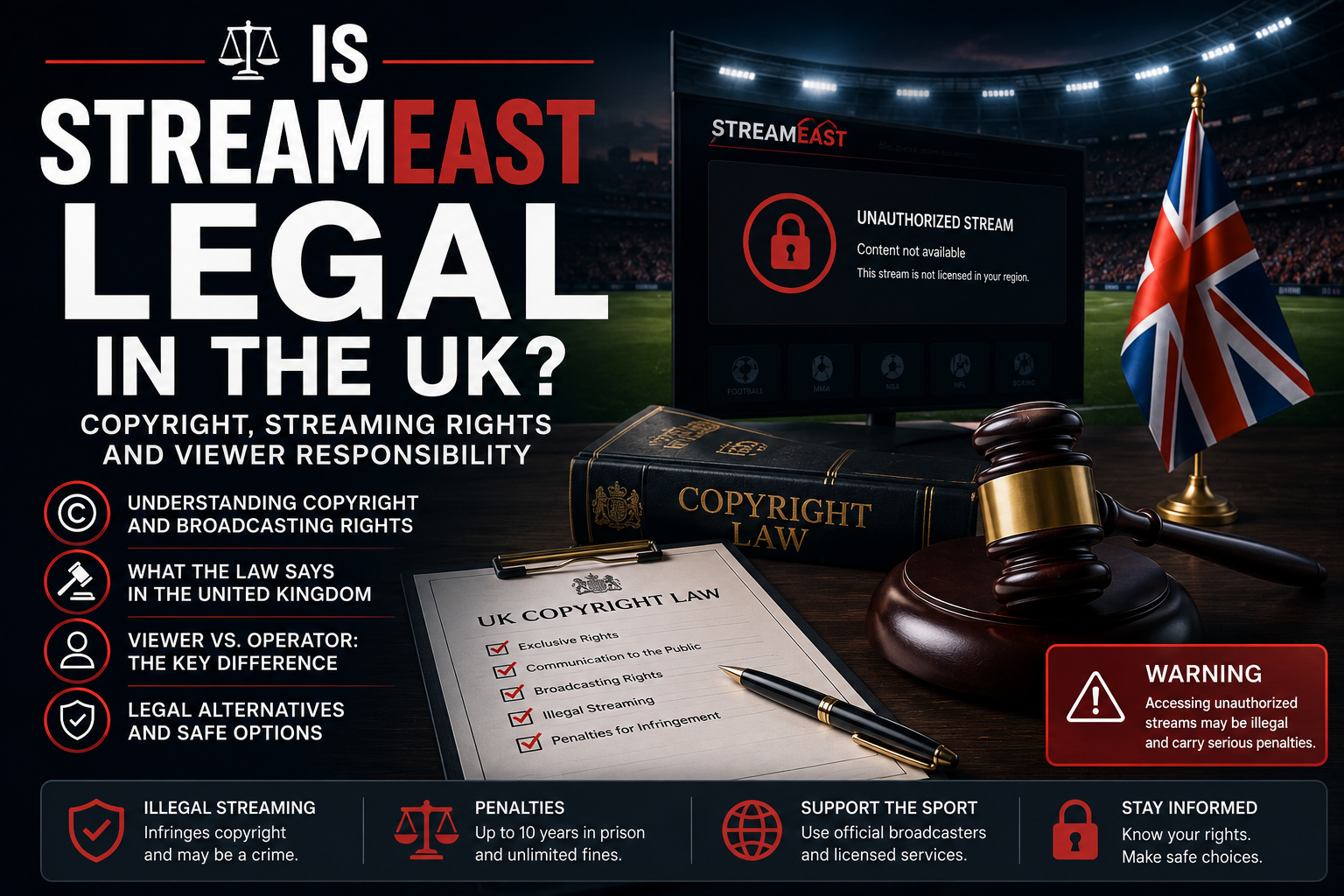
StreamEast became widely known because it appeared to offer a simple answer to a complicated problem. Instead of checking several broadcasters to find a football match, boxing event, Formula 1 race or American sports game, visitors could look through one schedule and select the event they wanted.
That convenience did not make the broadcasts authorised.
The former StreamEast network distributed live sport without permission from the leagues, broadcasters and other organisations that controlled the relevant rights. In September 2025, the Alliance for Creativity and Entertainment announced that the network had been shut down in cooperation with Egyptian authorities. ACE described it as the world’s largest illicit live sports streaming operation at the time, operating through 80 associated domains and recording more than 1.6 billion visits during the previous year.
Websites may continue to use the StreamEast, Stream East or East Stream names, but a copied identity does not change the legal position. When a page distributes subscription sports coverage without permission, changing the domain, logo or spelling does not make that coverage legitimate.
The simple answer is that the original StreamEast service was not a licensed sports broadcaster. In the UK, watching or distributing protected sport through an unauthorised source can involve copyright infringement. The degree of legal risk, however, depends heavily on what a person is doing. Someone who operates a commercial streaming network is in a very different position from a viewer who briefly lands on a webpage.
This article explains those differences without exaggerating them or pretending that general information can replace personal legal advice.
Was StreamEast Legal in the UK?
No. The original StreamEast network did not hold the rights required to distribute the sporting events associated with its websites.
ACE reported that the network offered unauthorised coverage of the Premier League, La Liga, Serie A, the Bundesliga, Ligue 1, UEFA competitions and international football. It also provided access to NFL, NBA, NHL and MLB games, along with boxing, mixed martial arts, Formula 1 and MotoGP.
These broadcasts were owned or licensed by leagues, production companies and media organisations. A separate website could not lawfully reproduce them simply because it had found a technical way to place the video inside an online player.
UK government guidance defines illicit streaming as watching content without the copyright owner’s permission. It makes clear that this can happen through a smart television, laptop, mobile phone, application or adapted streaming device.
The device does not determine whether the viewing is lawful. The important question is whether the person or service distributing the content has permission to do so.
How Sports Broadcasting Rights Work
A live sporting event involves several layers of commercial and creative work.
Cameras, commentary teams, graphics, production staff and technical infrastructure are used to create the broadcast. The league, event organiser or appointed agency then licenses the right to show that coverage in particular regions.
A broadcaster may buy the exclusive UK rights to a competition for several seasons. Another company may hold the rights in the United States, Europe, Asia or another market.
Those arrangements can also be divided by platform. Television, mobile streaming, highlights, radio commentary and public-venue coverage may be covered by separate agreements.
This is why the same match can appear on different broadcasters in different countries. It is also why a service available abroad may not have permission to show the event to UK viewers.
A website does not become an authorised broadcaster because it embeds a feed originally created by someone else. Permission must come from the relevant rights holder or an organisation authorised to grant it.
Copyright Protects More Than a Logo
Some viewers associate copyright mainly with films, music, books and photographs. Live sports broadcasting can seem different because the match itself is an event rather than a scripted creative work.
The broadcast around the event still contains protected material.
The recorded pictures, commentary, music, graphics, replays and production choices can all carry legal protection. Broadcasters also have specific rights in their broadcasts.
The Copyright, Designs and Patents Act 1988 gives copyright owners control over important uses of their work, including communication to the public. A person who transmits protected material through an online service without the required licence can therefore infringe copyright.
This is the central legal problem for an unauthorised sports-streaming network. It takes a broadcast created and licensed by others and communicates it to an audience without permission.
What Does “Illicit Streaming” Mean?
The UK Intellectual Property Office describes illicit streaming as watching content without the copyright owner’s permission by any means.
Its guidance specifically says this can involve a smart TV, laptop or mobile phone. It also explains that ordinary devices such as streaming sticks and Android television boxes are lawful when used for legitimate content but become part of illicit streaming when adapted to access subscription sport, television or films without the appropriate payment and permission.
This distinction is useful because it prevents the technology itself from being blamed.
A browser is legal. A streaming stick is legal. A media player is legal. A VPN is generally a legitimate privacy and networking tool.
None of those technologies grants permission to watch a protected broadcast from an unauthorised source.
The legality depends on how the tool is being used and where the content comes from.
Is Simply Watching StreamEast Illegal?
Official UK guidance takes a clear position: accessing protected sport through an unauthorised website, application, add-on or other illegal source infringes copyright and may amount to a crime.
That does not mean every viewer faces the same legal consequences as the operator of a large piracy network.
There is an important difference between:
- accidentally opening a page;
- knowingly watching an unauthorised broadcast;
- paying for a pirate subscription;
- sharing access with others;
- selling modified devices;
- operating a streaming website;
- capturing and redistributing a broadcast for profit.
The law considers conduct, knowledge, intention and surrounding circumstances. A person who builds a commercial service and distributes copyrighted sport to millions of visitors is not in the same position as someone who follows a misleading link and closes it immediately.
It would therefore be inaccurate to claim that every visit automatically leads to prosecution. It would be equally inaccurate to claim that watching is lawful simply because the viewer did not upload the broadcast.
The safest legal position is to use a broadcaster or service that has permission to show the event in the UK.
Viewers and Operators Do Not Face the Same Risk
The clearest and most serious criminal provisions around online copyright infringement are directed at people who communicate protected work to the public.
Section 107 of the Copyright, Designs and Patents Act provides that a person can commit an offence when they infringe copyright by communicating a work to the public, know or have reason to believe they are infringing, and either intend to make a financial gain or know that the communication will cause or risk financial loss to the copyright owner.
The Digital Economy Act 2017 strengthened these provisions and increased the maximum prison sentence on conviction on indictment for the relevant online copyright offence to ten years.
This language is particularly relevant to:
- operators of unauthorised streaming networks;
- people supplying the video feeds;
- commercial IPTV sellers;
- people selling access or subscriptions;
- those knowingly redistributing broadcasts for profit;
- people running services that expose rights holders to financial loss.
A viewer does not normally “communicate the work to the public” merely by watching it privately. However, viewers can become distributors when they restream the video, share it publicly, run a paid group or supply access to other people.
That change in behaviour can significantly change the legal risk.
Could an Ordinary Viewer Be Prosecuted?
UK government guidance says people accessing illegal content are infringing copyright and may be committing a crime.
Whether an individual viewer would actually face criminal proceedings depends on the facts and the evidence. Knowledge, intention, scale, repetition and commercial activity may all matter.
Public enforcement announcements commonly focus on people operating services, selling illegal subscriptions or supplying modified equipment. That reflects the greater harm and clearer evidence associated with commercial distribution.
It should not be interpreted as a guarantee that viewers are legally protected.
The fact that enforcement may concentrate on suppliers does not transform unauthorised viewing into authorised viewing. It simply means that different participants can face different practical levels of legal exposure.
Anyone who has received a legal warning, court document or direct allegation should not rely on a general website article. They should obtain advice from a qualified UK solicitor.
Does Free Access Make a Stream Legal?
No. Price does not determine whether a broadcast is authorised.
Some legitimate sporting events are shown free of charge. A recognised broadcaster may provide free-to-air television, a free online stream, official highlights or live coverage funded through advertising.
In those situations, the broadcaster has permission to show the content even though the viewer does not pay a separate fee.
An unauthorised service can also be free. It may earn money through pop-up advertising, redirects, gambling promotions, data collection or paid premium options.
The real question is not whether the viewer pays. It is whether the distributor has a licence from the rights holder.
A free broadcast on an official league, broadcaster or governing-body website can be lawful. A free feed copied from a subscription channel and placed on an unrelated website is not made lawful by the absence of an entrance fee.
Does Paying for Access Make It Legal?
Paying an unofficial service does not make its broadcasts authorised.
Some piracy services charge monthly fees, sell event access or request cryptocurrency payments. They may look more professional than free websites and promise stable, high-definition coverage.
Payment can create the impression that the customer has bought a legitimate product. In reality, the seller may have no authority to redistribute the channels or events included in the package.
UK government guidance warns that devices and applications become illicit when they are used to access subscription content without the appropriate permission. It also states that selling, advertising or supplying devices configured for illicit streaming is highly likely to constitute a criminal offence.
A low price is not evidence of a special wholesale agreement. When a service claims to offer nearly every premium sports channel for a fraction of the normal cost, that should be treated as a warning rather than a bargain.
Does Using a VPN Make StreamEast Legal?
No.
A VPN can change the internet address visible to a website and encrypt traffic between the device and the VPN provider. People use VPNs for ordinary business, remote work, public Wi-Fi protection and privacy.
A VPN does not grant broadcasting rights.
When a source is unauthorised, hiding or changing the apparent location of the viewer does not give the source permission to distribute the event.
There is also a separate issue when someone uses a VPN to access a legitimate service from outside the region covered by their subscription. That may breach the provider’s terms, even when the service itself is licensed.
The precise outcome depends on the agreement between the provider and customer. It should not be confused with the more fundamental problem of a pirate website having no distribution rights at all.
Does a TV Licence Make StreamEast Legal?
No.
A UK TV Licence and copyright permission are separate matters.
GOV.UK says a TV Licence is required when someone watches or records live television on any channel or service, or uses BBC iPlayer. This includes live television watched through an online service.
Holding a TV Licence does not grant access to every subscription broadcaster. It also does not authorise an unrelated website to redistribute protected sports coverage.
A viewer may therefore need both:
- a valid TV Licence where the activity requires one; and
- lawful access through the authorised broadcaster or service.
A TV Licence is not a substitute for a Sky, TNT Sports, league-pass or other legitimate subscription. Equally, paying an official subscription does not remove the need for a TV Licence when the customer watches live television and the licensing rules apply.
What About Streaming on a Phone or Laptop?
The legal position does not depend on whether the video appears on a television.
UK guidance explicitly includes smart televisions, laptops and mobile phones when describing illicit streaming.
Watching through a browser does not create an exception. Neither does using private browsing, casting the picture to a television or opening the stream through a mobile application.
The same principle applies to:
- desktop computers;
- tablets;
- games consoles;
- smart-TV browsers;
- casting devices;
- streaming sticks;
- mobile applications;
- media-centre software.
The screen is simply the way the viewer receives the content. It does not determine whether the source has permission to supply it.
Are Firesticks and Streaming Boxes Illegal?
Ordinary streaming devices are legal.
Millions of people use them with official applications for television, films, music and sport. Problems arise when the device is modified or supplied with software intended to provide unauthorised subscription content.
The Intellectual Property Office explains that these devices are lawful when used for legitimate free-to-air services. They become illicit when adapted to access subscription television, films or sport without the appropriate subscription and permission.
This distinction is often lost in everyday conversation.
A Fire TV Stick is not inherently illegal. Kodi is not inherently illegal. Android television hardware is not inherently illegal.
Selling a device as “fully loaded” with access to unauthorised premium channels is a different matter. The seller may face legal consequences, and the buyer may also be exposed to unreliable software, fraud and security risks.
Our guide to the StreamEast app looks more closely at unofficial applications and installation files.
Can Someone Share a Stream With Friends?
Private conversation about an event is not the same as redistributing the broadcast.
The situation changes when a person sends access to a large group, restreams the video, runs a public page or charges other people to watch.
The law’s communication-to-the-public provisions are particularly important where a person knowingly makes protected content available to an audience and intends to gain financially or knows the activity will cause or risk financial loss to the owner.
A person who restreams a football match through social media is not merely a viewer. They have become part of the distribution process.
The same concern applies to people who:
- capture a live broadcast and place it on another website;
- run paid messaging groups containing stream links;
- sell login details;
- supply IPTV subscriptions;
- charge admission to an unauthorised public screening;
- operate social accounts dedicated to sharing live feeds.
Adding a disclaimer such as “I do not own this content” does not create permission from the copyright owner.
Is Linking to a Stream Different From Hosting It?
A website may claim that it does not host video and merely provides links to other pages.
That wording does not automatically remove legal responsibility.
Legal liability can depend on the operator’s knowledge, involvement, commercial purpose and the way the service is organised. A page deliberately built to help an audience find unauthorised broadcasts is in a different position from an ordinary search result or a neutral discussion of news.
The facts matter. A website may control the event schedule, choose the destinations, embed third-party players and earn revenue from the visitors it sends to those players.
It would be unwise for an operator to assume that placing the actual video on another server makes the entire service lawful.
Anyone running a website, application or online group that points users towards unauthorised sport should obtain professional legal advice.
Does “Fair Use” Apply to Live Sports Streams?
“Fair use” is primarily an American legal expression. UK copyright law instead contains specific exceptions and the concept of fair dealing.
The exceptions cover limited circumstances such as criticism, review, quotation, news reporting, research and parody. They are not a general permission to reproduce a complete live broadcast.
Government guidance explains that fair dealing depends on the facts, including whether the use competes with the original and causes the copyright owner to lose revenue. A use acting as a substitute for the original is unlikely to be considered fair.
An unauthorised full-match stream is designed to replace the licensed broadcast for its audience. It is therefore very different from using a brief clip in a genuine news report or critical discussion.
Placing “for educational purposes” or “no copyright intended” on a page does not create a legal exception.
Is Recording a Sports Broadcast for Later Allowed?
UK copyright law contains a limited time-shifting exception.
Government guidance says a broadcast may be recorded in domestic premises for private and domestic use so that it can be watched at a more convenient time. It also says making a recording for purposes beyond personal or family time-shifting is likely to be illegal.
This exception does not authorise someone to obtain the broadcast from an illegal source.
It also does not allow the recording to be uploaded, sold or distributed to other people.
A lawful example would be recording a programme received through an authorised broadcast so that members of the household can watch it later.
Capturing an unauthorised live stream and sharing the recording publicly is a very different activity.
What About Clips, Highlights and Social Media?
Official sports organisations often publish short clips, goals, interviews and highlights on social media.
These posts are authorised because the publisher owns the material, holds the relevant rights or has permission to use it.
A random account uploading footage is not necessarily authorised simply because the clip is available on a major platform.
Social networks remove many sports clips after receiving reports from rights holders. The fact that a post remains online for several hours does not prove that it is lawful.
Sharing an official post through the platform’s normal tools is generally different from downloading the footage and uploading a new copy.
Viewers who want highlights should use recognised league, club, broadcaster or event accounts. These sources are also less likely to use misleading links or direct followers towards harmful pages.
Why Rights Holders Take Action
Sports broadcasting rights finance a large part of professional sport.
Broadcasters pay leagues and organisers for the ability to show events. They then rely on subscriptions, advertising and commercial agreements to recover that investment.
Unauthorised services avoid those costs while competing for the same audience.
Rights holders can respond through civil claims, domain action, blocking measures, criminal referrals and cooperation with international authorities.
Copyright owners decide how to enforce their rights when protected material is used without permission and no legal exception applies.
The StreamEast shutdown illustrates the scale that coordinated enforcement can reach. ACE said the network operated across 80 domains and drew most of its traffic from the United States, Canada, the United Kingdom, the Philippines and Germany before the 2025 action.
The international nature of the internet does not make operators unreachable. Domains, payment systems, hosting providers, advertising partners and individuals can all be located in different countries, requiring cooperation across borders.
Can Internet Providers Block Streaming Websites?
Rights holders may seek court orders requiring internet service providers to restrict access to infringing services.
A blocked page may display a notice, fail to load or return an error. This does not necessarily mean the viewer’s broadband is broken.
Unauthorised websites often respond by changing domains. This is one reason familiar streaming names appear across many addresses.
A new address is not evidence that a court decision, copyright claim or licensing problem has disappeared. It may simply be an attempt to continue the same activity somewhere else.
The constant movement also creates opportunities for copycats. A criminal or dishonest operator can register a similar name and claim to be the latest working version.
For this reason, our discussion of StreamEast addresses and domain variations is kept in one explanatory article rather than turned into a list of active links.
Does StreamEast’s Shutdown Affect Current Lookalike Sites?
The shutdown confirmed that the original network described by ACE was considered an illicit operation.
It does not automatically prove who operates every present-day website using the name.
A lookalike may be:
- an imitation created after the shutdown;
- a separate piracy service using familiar branding;
- an old domain under different control;
- an advertising page;
- a fraudulent subscription service;
- an unrelated website attempting to attract leftover traffic.
The legal status of each page depends on what it does and whether it has permission to show its content.
However, a page carrying unlicensed premium sport does not become lawful because it has no connection with the original StreamEast operators. It may simply represent a new and separate infringement.
Readers should avoid assuming that “not the original” means “legal.”
Are All Websites With Unofficial Sports Links Illegal?
Not every website discussing sports streams is doing the same thing.
A news article may report that piracy exists. A safety guide may explain the risks without providing access. A search engine may index pages automatically. A forum user may mention a service while discussing a match.
Those activities are not automatically equivalent to building a platform designed to help people watch unauthorised broadcasts.
Purpose and behaviour matter.
A website becomes more legally concerning when it actively organises infringing events, embeds players, promotes working mirrors, earns revenue from access or knowingly directs visitors to illegal broadcasts.
Stream-east.org.uk is an independent informational publication. It does not host sports broadcasts, embed unauthorised feeds or publish links intended to help readers access pirate streams.
Does a Disclaimer Protect a Streaming Website?
A disclaimer cannot replace permission.
Statements such as the following do not automatically protect an operator:
- “We do not own the content.”
- “All links are found on the internet.”
- “For educational purposes only.”
- “No copyright infringement intended.”
- “Users are responsible for their own actions.”
- “We only embed third-party players.”
The law looks at what the service actually does, not only at the wording placed in its footer.
A website knowingly organising and monetising access to unauthorised sport cannot necessarily avoid responsibility by saying that another server hosts the video.
Similarly, a viewer cannot make an unauthorised broadcast lawful by stating that they support the sport or intend to subscribe later.
How Can Viewers Recognise an Authorised Service?
Begin with the competition or event organiser.
A league, club, promoter or governing body will usually identify its broadcast partners by country. Make sure the information applies to the UK, as a service licensed elsewhere may not hold British rights.
Then check the broadcaster’s own schedule.
A legitimate provider should normally offer:
- a clear company identity;
- understandable subscription terms;
- transparent pricing;
- supported-device information;
- privacy and data policies;
- customer support;
- a recognised payment process;
- reliable application-store listings;
- information about cancellations and renewals.
A professional appearance alone is not enough. Unofficial services can copy league badges, match times and promotional photographs.
The safest evidence is confirmation from the rights holder or authorised broadcaster.
Our guide to finding the official broadcaster for a match explains the checking process in more detail.
What Should Previous StreamEast Users Do?
Someone who previously watched through StreamEast does not need to panic.
General online articles cannot determine whether a particular person has legal exposure. Anyone who has received direct correspondence from a rights holder, police force, court or solicitor should obtain individual legal advice.
For ordinary viewers, the practical next step is to stop relying on pages whose ownership and licensing cannot be verified.
Remove unfamiliar applications, cancel questionable subscriptions and review payment statements. Change passwords that were entered on unknown services, particularly when the same password was used elsewhere.
The safety concerns surrounding copycat pages are covered in is StreamEast safe?.
For future events, check official schedules before match day rather than searching for a stream at the last minute. This reduces the pressure that makes misleading websites more convincing.
Legal Alternatives Do Not Always Require Several Contracts
The lawful options vary by sport.
Some events are shown on free-to-air television. Others are available through flexible monthly services, official league products or one-off pay-per-view purchases.
Radio commentary, live text, official clips and delayed highlights can provide alternatives when a full subscription is not affordable.
Supporters may also be able to activate a service only during the part of the season they follow, provided they understand the cancellation terms.
Existing broadband, mobile and television packages should be checked as well. A household may already have access through a bundle without realising it.
Our guide to legal StreamEast alternatives for UK viewers covers these choices without presenting unverified replacement sites.
Viewer Responsibility Without Scaremongering
Discussions about illegal streaming often move between two unhelpful extremes.
One side suggests that nothing matters because “everyone does it.” The other implies that every person who opens an unauthorised player will immediately face arrest.
Neither view explains the law properly.
UK government guidance states that accessing illegal content infringes copyright and may involve criminal conduct.
At the same time, the most serious statutory provisions discussed in relation to online distribution focus on people knowingly communicating protected work to the public for gain or in circumstances that cause or risk financial loss.
Viewers should therefore understand two things at once:
Unauthorised viewing is not made lawful by convenience, popularity or low enforcement visibility.
Operating, selling and distributing an illegal service generally create much greater legal exposure than merely receiving a stream.
That balanced understanding is more useful than either reassurance or exaggeration.
The Legal Position in Plain English
StreamEast was not an authorised sports broadcaster.
The original network provided access to protected events without the required licences and was reported shut down as an illicit sports-piracy operation in September 2025.
In the UK:
- watching content without the copyright owner’s permission is described by official guidance as illicit streaming;
- accessing sport through an unauthorised website or application infringes copyright and may amount to a crime;
- a TV Licence does not make a pirate source lawful;
- paying an unofficial subscription does not create broadcasting permission;
- a VPN does not legalise an unauthorised stream;
- ordinary streaming devices are lawful, but using or supplying them for illicit subscription content creates legal problems;
- restreaming, selling or operating a commercial service carries substantially greater risk;
- copyright exceptions do not provide general permission to show complete live matches.
The most dependable approach is to check the official event organiser and authorised UK broadcaster before watching.
Stream-east.org.uk is an independent editorial publication. It is not affiliated with the former StreamEast network or with present-day websites using similar names. It does not host live sporting events, embed unauthorised video feeds or provide links to pirate broadcasts.
This article provides general information about the UK position and should not be treated as personal legal advice.