

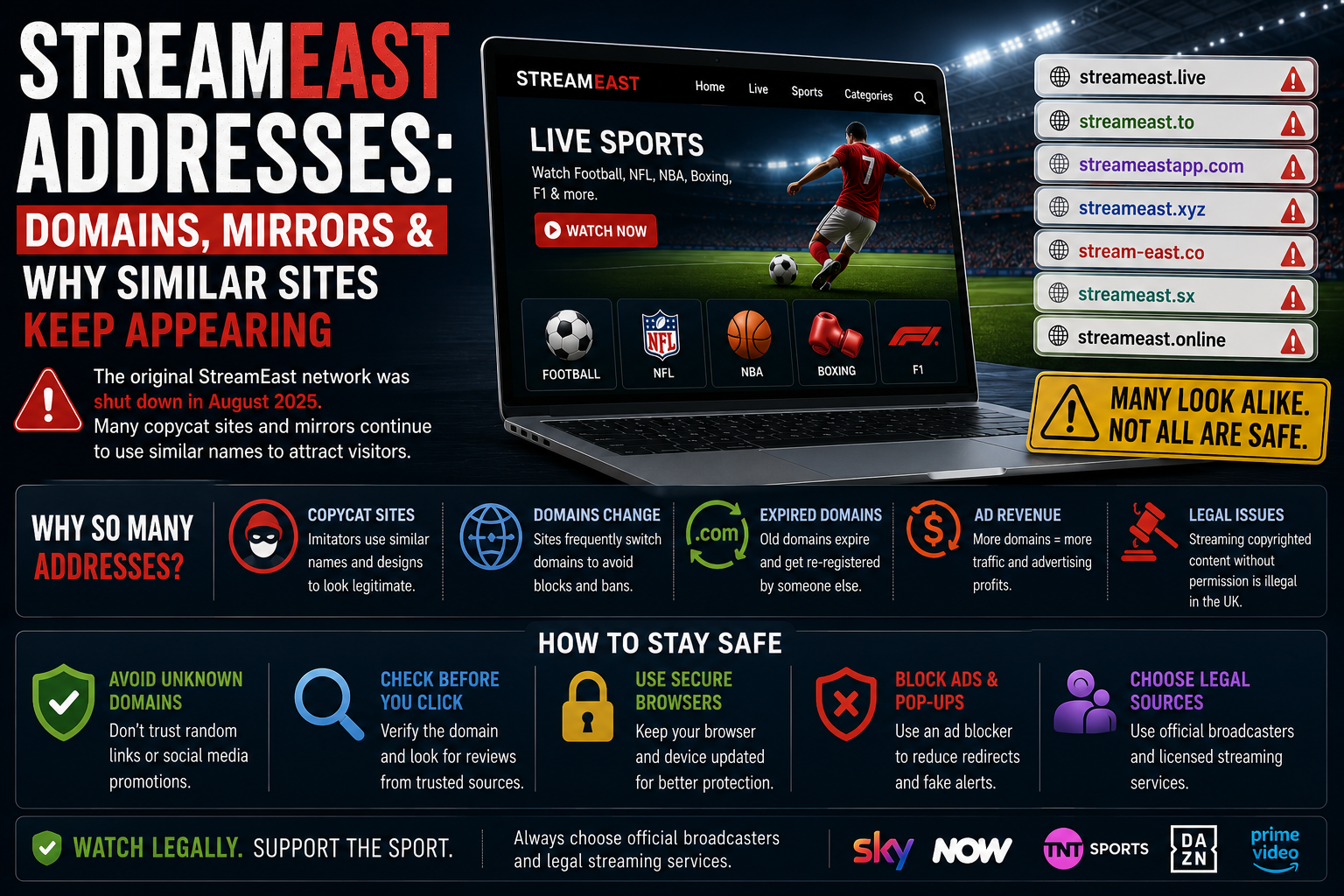
Anyone searching for StreamEast is likely to encounter more than one web address.
Some pages join the name into one word. Others present it as Stream East or reverse it to East Stream. Different domain endings may appear alongside claims such as “official,” “new,” “updated” or “working.”
This variety can make the service look as though it is constantly moving from one address to another. In reality, the situation is more complicated.
The original StreamEast network was reported shut down in September 2025 following an operation involving Egyptian authorities and the Alliance for Creativity and Entertainment. ACE said the network had operated through 80 associated domains, attracted more than 136 million average monthly visits and received over 1.6 billion visits during its final year.
After a widely recognised network disappears, its name can continue circulating through old bookmarks, online discussions, copied websites and unrelated domains. A page using familiar branding may be a clone, an impersonator, a repurposed address or a separate service trying to attract people who remember StreamEast.
The domain name alone cannot establish who operates a website today.
For that reason, all StreamEast address variations are covered in this one article. Individual domains will not be presented as separate platforms or described as confirmed working replacements.
Why Are There So Many StreamEast Addresses?
The original operation was not limited to one permanent homepage.
ACE identified 80 associated domains when it announced the shutdown. That structure allowed the network to remain visible through several addresses rather than depending on a single domain.
There are several reasons why an unofficial streaming network might use multiple addresses:
- one domain may become unavailable;
- an internet provider may restrict access;
- a registrar or hosting company may suspend a service;
- different addresses may target different sports;
- alternative spellings may attract more visitors;
- a new domain may be promoted when an older one stops working;
- copies may appear without any involvement from the original operators.
Before the shutdown, visitors became accustomed to the idea that StreamEast could appear at several locations. When one address failed, they looked for another.
That habit now benefits imitation websites.
A person may assume that a newly discovered page is simply the latest official address, even though it could have been created by a completely unrelated operator after the original network was dismantled.
What Is a Domain Name?
A domain name is the readable address used to reach a website.
It points the browser towards the servers providing the website’s content. The organisation or person controlling the domain can change where it leads, move it to another hosting provider or redirect visitors elsewhere.
Registering a domain does not give its owner rights to sports broadcasts, trademarks or another company’s identity. It simply provides control over that particular web address for as long as the registration remains active.
A convincing domain name is therefore not proof that a website is authorised.
Someone can register a name containing familiar words and create a page that resembles a service people already recognise. The technical ability to create the address says nothing about whether the operator has permission to distribute the content offered through it.
What Is a Mirror Site?
The term “mirror” usually describes another website containing the same or very similar material as an existing page.
A genuine technical mirror may be controlled by the same organisation and used to improve availability. In discussions about unofficial streaming, however, the word is often used much more loosely.
A page may call itself a StreamEast mirror even when there is no evidence that it shares ownership, infrastructure or management with the former network.
The description may be used because it sounds more trustworthy than “copy.”
Visitors should not assume that a page is genuine because:
- someone called it a mirror in a comment;
- it uses the same logo;
- its fixture list looks similar;
- it includes the word official;
- it appears on a list of alternatives;
- it was shared by another viewer;
- its video player worked once.
The only reliable way to establish continuity would be credible evidence about the people or organisation operating the service. A claim made by the website itself is not independent verification.
StreamEast, Stream East and East Stream
The name commonly appears in three forms:
- StreamEast;
- Stream East;
- East Stream.
These variations do not automatically represent three separate services.
StreamEast is the best-known presentation. Stream East separates the words, while East Stream reverses their order. The different versions may appear because of typing habits, memory, autocomplete suggestions or deliberate attempts to capture visitors using alternative wording.
A website operator can place all three forms across the same page. That does not create three independent brands.
The individual guides on StreamEast, Stream East and East Stream examine different reader concerns, but address and domain variations remain together here so that no unknown website is presented as a separate verified platform.
What Happened to the Original Domains?
ACE announced the dismantling of the StreamEast network on 3 September 2025. It said associated domains would redirect visitors towards information about legitimate viewing services.
A redirected domain no longer displays the page the visitor originally expected. Instead, its technical settings send the browser to another destination.
Other domains may behave differently over time.
An address may:
- display an enforcement or information notice;
- stop resolving completely;
- show a server error;
- expire;
- be transferred;
- lead to a parked advertising page;
- become available for registration;
- later be used by someone else.
ICANN explains that when a registrant loses the rights to a domain, another person may eventually register it. A domain can also be suspended, deleted, transferred or placed under another registrant’s control.
This means an old address does not carry a permanent identity.
A website that once belonged to one operator could later display completely unrelated material.
Can an Expired Domain Get a New Owner?
Yes.
A domain is normally registered for a fixed period. The holder must renew it to continue controlling it.
When the registration is cancelled, deleted or allowed to expire beyond the available recovery period, the address may eventually become available for somebody else to register. ICANN warns that a domain no longer renewed may be released and registered on a first-come, first-served basis.
This is particularly important when dealing with old streaming addresses.
A bookmark saved several months or years earlier may no longer lead to the same operator. The new owner could use the remaining traffic for advertising, unrelated content or deceptive activity.
Previous reputation should never be transferred automatically to the current website.
The page should be assessed according to what it is doing now.
Can a Domain Change Without Expiring?
Yes.
A domain can be transferred from one registrar to another or from one registrant to another. Its hosting and nameserver settings can also be changed without altering the visible address.
ICANN’s policies allow registered holders to transfer domains and change registrant information through their registrar’s established processes.
From the visitor’s perspective, the address may look identical even though the organisation behind it, the server hosting it or the content displayed through it has changed.
That is why saying “I have used this address before” is not enough to establish present-day safety.
The domain may still be spelled the same while its ownership, advertising or purpose is completely different.
Why Do Copycat Sites Use Familiar Names?
A recognised name already has an audience.
StreamEast attracted enormous traffic before the original network was dismantled. Even after the shutdown, people continued remembering the brand and searching for it.
A new website using similar wording does not need to build recognition from nothing. It can benefit from people who already expect the name to lead to live sport.
Copycat pages may reproduce:
- dark sports-themed designs;
- red-and-white branding;
- event schedules;
- league logos;
- team badges;
- countdown timers;
- video-player layouts;
- categories for football, NFL, NBA, boxing or Formula 1.
These details are relatively easy to recreate.
A correct fixture time proves only that the operator has access to public scheduling information. It does not prove that a legitimate or dependable broadcast exists behind the play button.
What Is Typosquatting?
Typosquatting involves registering addresses that resemble a familiar domain or brand.
The difference may be only one letter, a missing character, an extra hyphen or a different word order. The purpose is to attract people who type the name incorrectly or fail to notice the change.
With StreamEast, the risk is increased by the fact that several spellings already feel natural.
A visitor may not notice whether:
- the words are joined or separated;
- a letter has been added or removed;
- a hyphen has appeared;
- the word order has changed;
- the domain ending is different;
- another word has been added to suggest official status.
The page may then imitate familiar branding to reduce suspicion.
NCSC systems use typo-related and brand-matching techniques when identifying domains that resemble phishing patterns, reflecting how commonly deceptive sites rely on familiar-looking addresses.
A minor spelling difference should not be dismissed, especially when the page requests login or payment information.
Does the Domain Ending Matter?
Domain endings can indicate a category or geographic namespace, but they do not prove that a website is official.
A .uk address does not automatically mean the operator is a recognised British company. A .com address does not establish international legitimacy, and a country-code ending does not necessarily show where the operator is physically located.
Modern websites can use many types of domain endings.
The ending should therefore be considered alongside:
- the company identity;
- contact information;
- registration history;
- broadcaster confirmation;
- privacy and payment terms;
- the behaviour of the page.
An unfamiliar ending is not proof of wrongdoing. A familiar ending is not proof of trustworthiness.
Does HTTPS Mean the Address Is Genuine?
No.
HTTPS means that information travelling between the browser and the website is encrypted. The padlock is useful because it reduces the chance of another party reading the connection while it is in transit.
It does not prove who owns the website or whether the operator is honest.
A copied page can obtain a valid security certificate. The visitor may therefore have an encrypted connection to a website designed to collect passwords, card details or advertising clicks.
The padlock does not verify:
- sports broadcasting rights;
- affiliation with the former StreamEast network;
- the identity of the company;
- the safety of downloads;
- the honesty of subscription terms;
- the quality of the video source.
A certificate warning is a serious reason not to enter information, but the absence of a warning is not a complete safety check.
Why Does One Address Redirect to Another?
Websites use redirects for many legitimate reasons. A company may move to a new domain, update an old page or direct mobile visitors towards an application.
Unofficial streaming pages can use redirects less transparently.
Pressing an address or play button may send the visitor through:
- an advertising network;
- a gambling page;
- a software offer;
- a subscription form;
- a fake verification screen;
- another streaming domain;
- several intermediate websites.
The destination may change each time.
A page can also redirect automatically when it detects a particular country, browser or device.
Visitors should check the address after every unexpected movement. A familiar-looking homepage does not mean the browser remained on the domain originally entered.
Repeated movement between unrelated sites is a reason to close the page rather than continue.
Why Does an Address Work for One Person but Not Another?
Two people can enter the same domain and receive different results.
Possible reasons include:
- the page behaves differently by country;
- internet providers apply different restrictions;
- the domain has recently changed its technical settings;
- cached information sends one visitor to an older destination;
- the service blocks certain networks or devices;
- advertising systems choose different redirects;
- one person is visiting a copied spelling without noticing;
- DNS changes have not reached every network at the same time.
This variation does not establish that one person has found the correct official address.
It demonstrates why informal reports such as “it works for me” are weak evidence.
The other person may be seeing a different page, advertisement or server response despite using what appears to be the same name.
Why an Address Can Work Today and Fail Tomorrow
Unofficial streaming websites are unstable by nature.
Their domains may face copyright complaints, registrar action, hosting removal or blocking. Their embedded players can also disappear without the domain itself going offline.
A page that works during one event may fail during the next because:
- its source was removed;
- the server became overloaded;
- the domain was suspended;
- the operator changed addresses;
- the website was abandoned;
- the advertising system replaced the destination;
- the domain moved to another owner.
Past availability cannot guarantee future reliability.
This is why our StreamEast not working guide focuses on explaining errors rather than promising that a page will return.
Why This Article Does Not Publish a Working Address List
A list of supposed working StreamEast addresses would create several problems.
First, the original network was reported dismantled. A current page should not be labelled official without credible evidence that can be independently checked.
Second, domain ownership and behaviour can change. A page that appears relatively harmless when an article is published could later redirect visitors towards something completely different.
Third, providing direct access would turn an informational article into a directory for unauthorised sports streams.
Finally, such lists can create false confidence. Readers may assume that inclusion means an address has been approved, verified or judged safe.
This website therefore discusses address patterns, ownership uncertainty and warning signs without publishing working StreamEast links or mirror directories.
Can Search Results Confirm the Official Address?
Not necessarily.
Search engines organise pages according to their own systems. A high position does not establish legal broadcasting rights or verified affiliation.
An imitation page may appear prominently because it:
- uses the familiar name repeatedly;
- has accumulated links;
- publishes many event pages;
- buys advertising;
- receives heavy traffic;
- has existed for some time.
Sponsored search results should be assessed just as carefully as ordinary ones.
A dishonest website can pay for advertising or use convincing language in its description.
For authorised sport, begin with the league, competition, club, promoter or governing body. Their official pages can identify the licensed UK broadcaster.
Can Social Media Confirm a StreamEast Address?
A social account is not reliable simply because it has many followers or uses the correct logo.
Accounts can be copied, renamed, sold or compromised. A post may claim that StreamEast has moved to a new address while directing users towards an unrelated page.
Be cautious around posts that:
- create urgency before a major match;
- promise a permanent new domain;
- ask users to bookmark immediately;
- provide shortened links;
- request private messages for access;
- direct viewers towards an application download;
- claim registration is required;
- offer lifetime access for a small payment.
A genuine broadcaster can normally confirm its website through several established channels, including its company site and recognised application listings.
An anonymous social account does not provide the same level of accountability.
Why Comment Sections Are Unreliable
Comments under sports posts often fill with links shortly before an event begins.
Some may be shared by ordinary viewers. Others may be automated messages or promotions posted by the people operating the destination pages.
The sender may write that the stream is tested, safe or advertisement-free. There is usually no evidence supporting those claims.
Comments can also remain visible after the linked domain changes ownership or stops working.
Do not assume that a link is safe because several accounts recommend it. The accounts may be connected, copied or automated.
Shortened Links Hide the Destination
A shortened link replaces the full address with a smaller redirecting URL.
These services have legitimate uses, particularly where space is limited. They also prevent visitors from seeing the final domain before opening it.
That makes them risky when shared by an unknown sports account or comment.
The link may lead to:
- a streaming page;
- an application file;
- a fake login form;
- a subscription offer;
- an advertising chain;
- an unrelated website.
A viewer should not need to follow an obscured destination to find an authorised broadcaster.
Be Careful With QR Codes
A QR code is another way to hide a destination until it is scanned.
Television pages, social posts and printed adverts may use them to direct viewers towards a supposed new StreamEast address or application.
Before opening the result, inspect the destination shown by the phone.
Do not continue when the page:
- uses an unfamiliar domain;
- begins downloading a file;
- asks for a recognised account password;
- requests card information for free verification;
- tells the user to disable security settings;
- claims that an application must be installed immediately.
A QR code does not provide any extra proof that the destination is trustworthy.
Should You Use a WHOIS or Domain Lookup?
Domain-registration lookup services can provide useful technical information, including the registrar and certain registration records.
ICANN maintains a registration-data lookup tool, and its guidance says such tools can help identify the registrar associated with a domain.
The results have limits.
Privacy services may hide the registrant’s personal details. A recent registration can suggest that a page is new, but an older domain can still change ownership or purpose.
Registration information also does not prove that a website holds sports rights.
A domain lookup can help answer technical questions, but it should not be treated as a complete authenticity test.
Warning Signs Around a StreamEast Address
Leave the page when several of these signs appear together:
- the domain differs from the displayed brand;
- the page repeatedly calls itself the only official version;
- several play buttons overlap;
- touching the player opens unrelated tabs;
- a file downloads without a clear request;
- the website asks for browser-notification permission;
- a false virus warning fills the screen;
- card details are requested for free verification;
- no identifiable company is named;
- subscription terms are missing;
- the page asks for a major account password;
- a special extension or player is required;
- the browser displays a certificate or safety warning;
- the website moves through several domains;
- the supposed support service operates only through private messages.
A correct fixture list should not outweigh these concerns.
What If an Old Bookmark Opens a Different Website?
Close the page and delete the bookmark.
The domain may have expired, changed ownership or been redirected.
Do not assume that the new content has any relationship with the page previously saved.
Check whether the browser downloaded anything or granted notification permission. When login or payment details were entered, take the appropriate security steps immediately.
An old bookmark is a record of an address, not a guarantee about whoever controls it today.
What If You Entered a Password?
Change it through the genuine website or application belonging to the affected account.
Also change it wherever the same password was reused, beginning with email.
Enable two-step verification or a passkey where available. Review recent login activity and remove sessions or devices that are not recognised.
Do not return to the suspicious domain to change the password inside its own account system.
The NCSC warns that fake websites can be designed to steal passwords and other personal information.
What If You Entered Card Details?
Contact the bank or card provider through its official application, website or the number printed on the card.
Explain what was entered and whether a payment was approved.
Check for:
- small verification charges;
- recurring subscriptions;
- an unfamiliar merchant name;
- payments larger than the displayed amount;
- further attempts after the card was used.
Do not rely on cancellation information supplied by the suspicious streaming page.
Removing a bookmark or closing the website does not cancel a payment agreement.
What If a File Was Downloaded?
Do not open an unknown file simply to identify it.
Remove it from the download folder and run the device’s trusted security checks.
When an application was installed, remove it and review the permissions it held. Change passwords entered through the software and inspect financial accounts when card information was submitted.
The StreamEast app guide provides more detailed advice for Android, iPhone and television applications.
Can a Suspicious Address Be Reported?
Yes.
The UK National Cyber Security Centre accepts reports of suspicious websites and says reports can help it investigate scam pages and protect other users.
A person does not need to prove that a website is fraudulent before submitting a report.
The domain registrar may also provide an abuse-reporting process. NCSC guidance recommends identifying the registrar and using its published abuse contact when seeking action against malicious content.
Do not revisit a dangerous-looking page solely to gather more information. Use details already available from the browser history, message or advert through which it was received.
How to Find the Real Broadcaster Instead
When a StreamEast address fails, searching for another variation is not the safest or most reliable solution.
Begin with the organisation responsible for the sport.
Check:
- the league, tournament, club, promoter or governing body;
- its UK broadcasting information;
- the broadcaster’s official schedule;
- whether the event is included in a subscription;
- whether a separate event purchase is required;
- which devices and applications are supported.
The correct broadcaster may vary between competitions, even when the same team or athlete is involved.
Our guide to finding the official sports broadcaster explains this process, while legal StreamEast alternatives for UK viewers compares broader viewing options.
A Familiar Address Is Not a Permanent Identity
The central problem with StreamEast addresses is not simply that there are many of them.
It is that visitors often treat the address as proof of continuity.
Domains can expire, transfer, redirect or change ownership. New operators can register similar spellings and reproduce familiar designs. The word mirror can be used without proving any connection with the original service.
The StreamEast network identified by ACE was reported dismantled in 2025. Current websites using its name should therefore be assessed as independent pages unless reliable evidence establishes otherwise.
Do not trust a page because its address looks familiar or because someone says it worked yesterday. Check the operator, avoid unknown downloads, keep security warnings active and use the authorised broadcaster for the event.
Stream-east.org.uk is an independent informational publication. It is not affiliated with the former StreamEast network or with websites currently using similar names. It does not publish working mirror lists, host sporting broadcasts or provide links to unauthorised streams.