

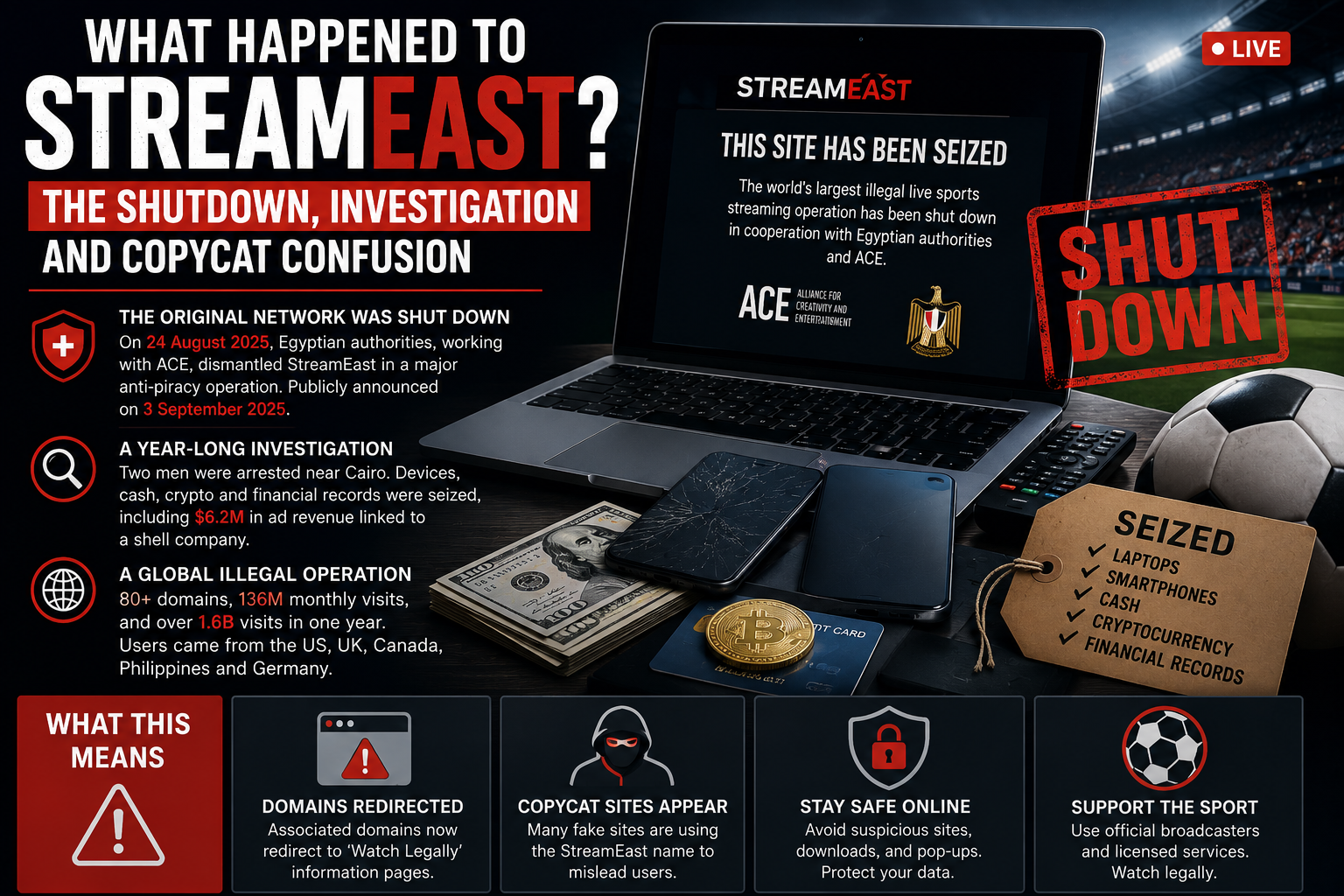
StreamEast did not simply disappear because of an ordinary website outage. The original network was targeted in an international anti-piracy operation and reported shut down in August 2025, with the enforcement action publicly announced on 3 September 2025.
The scale of the operation explains why the story attracted so much attention. StreamEast had become one of the most recognisable names in unofficial sports streaming, offering unauthorised access to football, American sports, boxing, mixed martial arts and motorsport through a network of related websites.
According to the Alliance for Creativity and Entertainment, the network operated through 80 associated domains, received more than 136 million average monthly visits and recorded over 1.6 billion visits during the preceding year. ACE described it as the world’s largest illicit live sports streaming operation at the time.
Its closure did not make the StreamEast name disappear. Similar-looking pages continued to appear, creating confusion about whether the original service had returned, whether some parts had survived or whether unrelated operators were simply copying a valuable identity.
The most accurate answer is that the network identified by ACE was reported dismantled. Websites that continued using StreamEast, Stream East or East Stream branding could not automatically be treated as the original platform. Some may have been copies, impersonators or separate services attempting to attract its former audience.
This article explains the shutdown, the investigation behind it, what reportedly happened during the raid and why the name can still be found online.
What Happened to StreamEast in Simple Terms?
StreamEast was investigated as a large-scale sports-piracy operation.
Egyptian authorities, working with the Alliance for Creativity and Entertainment, disrupted the network during an operation reportedly carried out on 24 August 2025. The public announcement followed on 3 September.
Two men were reportedly arrested near Cairo on suspicion of copyright infringement. Authorities also seized laptops, smartphones, cash and financial material allegedly connected with the operation.
Investigators reportedly identified a shell company suspected of being used to move advertising income generated by the websites. The amount associated with that alleged scheme was reported to be approximately $6.2 million, alongside about $200,000 held in cryptocurrency. Several Egyptian properties were also alleged to have been purchased using proceeds connected with the operation.
These were reported allegations connected with the enforcement action, not findings that this article can independently establish. The important point for ordinary viewers is that the operation targeted the people, infrastructure and finances believed to be supporting the network—not merely one homepage.
When Was StreamEast Shut Down?
The disruption reportedly took place on 24 August 2025 after an investigation lasting roughly a year.
ACE publicly announced the shutdown on 3 September 2025. That is why some viewers noticed unavailable pages and broken streams before the formal announcement appeared in the news.
The timing also attracted attention because it came shortly after the beginning of the European football season and immediately before the opening of the NFL regular season.
Many visitors were looking for live fixtures during this period, so failed pages and missing streams became noticeable quickly.
A website that suddenly stopped working in late August or early September 2025 may therefore have been affected by the enforcement action rather than an ordinary technical problem.
Our guide to why StreamEast is not working examines the difference between a dismantled domain, an unavailable server and a local browser problem.
Who Shut StreamEast Down?
The operation involved Egyptian authorities and the Alliance for Creativity and Entertainment.
ACE is an anti-piracy coalition supported by major entertainment and media companies. Its work includes investigations, legal action, criminal referrals and cooperation with authorities in different countries.
The organisation said the StreamEast action demonstrated how international coordination could be used against a large online network operating across numerous domains and serving visitors in several regions.
Reporting on the investigation also said assistance came from organisations including Europol, the United States Department of Justice, the Office of the United States Trade Representative and the National Intellectual Property Rights Coordination Center.
The enforcement action was centred in Egypt because the suspected operators and parts of the operation were reportedly located there.
The audience, however, was international. ACE identified the United States, Canada, the United Kingdom, the Philippines and Germany as the main sources of traffic to the network’s domains.
Why Was StreamEast Targeted?
StreamEast was not targeted because it discussed sport, published fixture information or offered ordinary commentary.
The network was accused of distributing live sporting broadcasts without permission from the organisations and broadcasters that owned the rights.
Sports broadcasting rights are sold through commercial agreements. A broadcaster may pay for the exclusive right to show a league, tournament or event within a particular country.
An unrelated website cannot lawfully take that coverage and distribute it to its own audience simply because the video can be captured or embedded.
The size of the StreamEast network made it a particularly significant target.
ACE said the service had received over 1.6 billion visits in one year across 80 domains. This placed it far beyond a small, temporary webpage and made it an international operation with a substantial audience.
The network was also associated with a wide range of premium sports rather than one competition. That increased its impact on broadcasters and rights holders across several markets.
How Large Was StreamEast Before the Shutdown?
StreamEast’s reported scale was one of the most striking parts of the announcement.
ACE said the network received more than 136 million average monthly visits. Across the final year, the total exceeded 1.6 billion visits.
Those figures covered the wider network rather than one web address.
This distinction matters because many viewers remember StreamEast as a single website. In reality, it operated through dozens of associated domains.
Some addresses may have focused on particular sports, while others presented broader event schedules. Domains could disappear, change or redirect while the StreamEast identity continued elsewhere in the network.
This structure created resilience. If one domain became unavailable, visitors could be directed towards another.
It also created lasting confusion after the shutdown. People had already learned that the name could appear at several addresses, making them more likely to believe that a new lookalike was simply another genuine replacement.
What Sports Were Available Through StreamEast?
Football was a major part of the network.
ACE said StreamEast provided unauthorised access to matches from:
- the Premier League;
- La Liga;
- Serie A;
- the Bundesliga;
- Ligue 1;
- the Primeira Liga;
- UEFA club competitions;
- international qualifiers;
- Major League Soccer;
- domestic American football competitions.
The network was also associated with sport-specific pages covering the NFL, NBA, NHL and MLB.
Boxing, mixed martial arts, Formula 1 and MotoGP were included as well.
This broad coverage helped the platform build a large international audience.
A football supporter might visit during a European match, while another user arrived for an NBA game, a UFC event or a Formula 1 race.
The service was not limited to occasional major events. Its appeal came from presenting a daily schedule across many leagues and sports.
That breadth also made the brand valuable after the shutdown. A copycat page using the name could attract several different audiences rather than relying on one competition.
How Did StreamEast Make Money?
Visitors generally associated StreamEast with free access, but a free website can still generate substantial revenue.
Unofficial streaming pages often earn money through:
- display advertisements;
- pop-up advertising;
- redirects to third-party websites;
- betting and gambling promotions;
- paid placements;
- referral arrangements;
- data collection;
- premium or registration offers.
The investigation reportedly connected approximately $6.2 million in advertising income with a shell company in the United Arab Emirates. Authorities also reportedly identified cryptocurrency holdings and property purchases believed to be linked with the proceeds.
These figures were allegations reported at the time of the enforcement action.
They illustrate an important point: visitors did not necessarily need to pay a subscription for the network to be commercially valuable.
A large audience generates advertising impressions and clicks. Even a person who never enters payment details may contribute revenue by opening the page, pressing a disguised button or being redirected to another service.
This helps explain why copied streaming websites can remain profitable even when their video players are unreliable.
What Was Reportedly Seized?
Reporting on the operation said authorities confiscated laptops and smartphones believed to have been used in running the network.
Cash, several credit cards and cryptocurrency holdings were also reportedly identified.
The seized devices may have been important because a modern streaming operation depends on far more than a public-facing website.
Operators may use devices and online accounts to manage:
- domains;
- hosting;
- advertising relationships;
- payment accounts;
- video sources;
- site updates;
- communications;
- visitor traffic;
- technical infrastructure.
Removing or gaining access to that infrastructure can disrupt the wider operation more effectively than blocking one address.
The reported seizure also helps explain why several pages may have failed around the same period. If central systems or accounts were disrupted, numerous associated domains could be affected at once.
What Happened to the StreamEast Domains?
ACE said the StreamEast websites would redirect to its “Watch Legally” information page following the shutdown. The Associated Press reported the same outcome for domains associated with the network.
A redirect can occur when control of a domain or its technical configuration changes.
Instead of loading the former event schedule, the browser sends the visitor to a different destination.
Not every old address will necessarily behave in exactly the same way forever. Domains can expire, be transferred, become inactive or later be controlled by a different party.
This is why an old StreamEast address should not be considered permanently safe or permanently connected with the same operator.
Even when a domain once belonged to the original network, its present ownership and behaviour may be different.
Did Every StreamEast Website Disappear Immediately?
No. Reports published around the shutdown noted that several sites using StreamEast branding still appeared active.
The Verge reported seeing pages listing sports fixtures and said ACE was aware of copycat websites. ACE was reportedly investigating whether those pages had any relationship with the dismantled operation or were impersonators attempting to use the name.
This does not contradict the shutdown announcement.
A large brand can be copied by people who were never part of the original operation. New domains can be registered quickly, while older imitation pages may already exist before an enforcement action occurs.
The continued appearance of the name therefore does not prove that the original network survived intact.
It proves that shutting down infrastructure is easier than removing every copied use of a recognised identity.
Why Did Some People Believe StreamEast Had Returned?
StreamEast users were already accustomed to domain changes.
Before the shutdown, a person might find that one address no longer worked and then move to another with a slightly different spelling or domain ending.
That behaviour became part of the viewing routine.
After the enforcement action, the same habit made copycat pages appear believable. A visitor who discovered a new address might assume that the network had simply moved again.
Several visual features could reinforce that impression:
- the StreamEast logo;
- a dark sports-themed design;
- familiar categories;
- a list of current fixtures;
- league and team badges;
- a video-player layout;
- wording such as “official” or “new home.”
None of these features verifies the operator.
A fixture list can be generated from publicly available schedules. Branding can be copied, and a website can describe itself as official without independent evidence.
Is Any Current StreamEast Site the Original?
The shutdown announcement established that the network identified by ACE had been dismantled.
It did not provide a reliable public method for viewers to authenticate every website that later used the same name.
At the time of the initial reports, ACE said it was examining websites that continued appearing under StreamEast branding and whether they were related or simply impersonators.
That uncertainty means readers should avoid declaring a present-day page genuine based only on appearance or claims made by the page itself.
A current service might be:
- an independent piracy operation;
- a copy created after the shutdown;
- a pre-existing imitation;
- an advertising page;
- a domain under new ownership;
- a fraudulent registration or payment site;
- an unrelated sports-information page.
The responsible description is that such websites use the StreamEast name. Without reliable evidence, they should not be presented as confirmed continuations of the original network.
Why Are Copycat Streaming Sites a Problem?
Copycats benefit from trust they did not earn.
A visitor may recognise the name and lower their guard, believing they are returning to a familiar service.
This can make them more likely to:
- press repeated play buttons;
- allow browser notifications;
- create an account;
- reuse a password;
- enter card details;
- download an application;
- install a browser extension;
- ignore a security warning.
The copied website may provide no dependable stream at all. Its main purpose could be generating advertising clicks or collecting information.
Even when a video works, the page may still be operated by an unknown organisation with unclear privacy and security practices.
Our guide examining whether StreamEast is safe explains the risks surrounding redirects, downloads, account forms and browser permissions.
Did the Shutdown End Sports Piracy?
No single enforcement action can end online sports piracy.
A successful shutdown can remove a major network, disrupt its finances and make its known domains unavailable.
It cannot remove the underlying demand for cheap and convenient sports coverage. Nor can it prevent every unrelated person from creating a new website.
The Associated Press noted that sports rights are frequently divided between multiple broadcasters, sometimes leaving supporters needing several subscriptions to follow the competitions they care about.
That fragmentation helps explain why unofficial streaming remains attractive.
However, frustration with prices does not establish that a copycat service is safe, authorised or likely to work.
New services may emerge, but they face the same issues involving copyright enforcement, unstable domains, uncertain ownership and aggressive advertising.
Why Sports Piracy Networks Use Many Domains
A multi-domain structure helps an unauthorised service continue operating when individual addresses become unavailable.
Domains may be blocked, suspended, reported or removed. Maintaining several versions allows an operator to direct visitors elsewhere.
Different domains can also target separate audiences or sports.
One might be associated mainly with football, while another uses names connected with basketball, American football or motorsport.
The structure can provide marketing advantages as well. More domains mean more opportunities to appear in searches and collect visitors through spelling variations.
The weakness of this approach is that each domain creates another point that investigators, registrars and hosting companies can examine.
Once the wider operation is mapped, enforcement can target the network rather than reacting to one page at a time.
ACE’s reference to 80 associated domains suggests that investigators viewed StreamEast as an organised system rather than a collection of unrelated websites.
Why Was the StreamEast Name So Valuable?
The name had become a shortcut for live sport.
Many visitors did not know or care which individual domain they were using. They remembered StreamEast and expected to find an event schedule.
That kind of recognition has commercial value.
A copycat does not have to build an audience from the beginning. It can attract people who are already looking for the former service.
The brand also crossed sporting boundaries. It was associated with football, NFL, NBA, boxing, MMA and motorsport, giving imitators access to a wide potential audience.
This is why the name can survive even after the original infrastructure has been dismantled.
The network disappeared as an identified operation, but public awareness of the name remained.
Why Did the Shutdown Happen in Egypt?
The enforcement operation took place in Egypt because the suspected operators and parts of the network were reportedly based there.
Two men were reportedly arrested near Cairo during the action. Devices and financial material linked with the alleged operation were also seized there.
Online services often have no obvious physical location from the viewer’s perspective.
A website can serve visitors in the UK, use a domain registered elsewhere, rely on hosting in another country and generate payments through an additional jurisdiction.
Investigators therefore have to connect digital activity with people, companies, financial accounts and physical infrastructure.
The StreamEast case shows how an internationally accessed website can still be vulnerable when authorities identify the individuals and systems believed to be operating it.
What Did the Shutdown Mean for UK Viewers?
UK visitors formed one of the network’s main audiences, according to ACE.
For those viewers, the immediate effect was that familiar addresses stopped loading, redirected elsewhere or no longer provided the expected event schedule.
Some users then encountered competing websites claiming to be the correct replacement.
This increased several risks.
A person searching urgently before kick-off might visit an imitation page, follow an advertising link or download software from an unknown operator.
The shutdown also made older online recommendations unreliable. A forum comment or saved bookmark created before August 2025 could now lead nowhere or open a page controlled by somebody else.
UK viewers should therefore check current official broadcasting information rather than relying on an address remembered from an earlier season.
Was StreamEast Closed Because It Was Unsafe?
The principal reason given for the shutdown was copyright infringement and unauthorised sports distribution.
Safety concerns were part of the wider criticism of illegal streaming services, but they were not the same issue.
A website can be unauthorised without directly infecting every visitor’s device. It can also use HTTPS and still have no right to distribute the broadcast.
Equally, a copycat page can create additional safety risks through false play buttons, intrusive advertising, downloads and misleading account forms.
Legality and safety should therefore be considered separately:
- Legal status concerns permission to distribute the broadcast.
- Safety concerns how the page, advertisements and downloads affect visitors and their information.
A site can fail both tests at once, but passing one technical check does not prove it passes the other.
Were the Operators Convicted?
The reports published at the time described arrests and allegations connected with copyright infringement and suspected financial activity.
An arrest is not the same as a conviction.
Legal cases can take time, and the final outcome may depend on evidence, local law and later court proceedings.
This article does not assume guilt beyond what was publicly reported about the enforcement action.
For readers, the shutdown of the network and redirection of associated domains are the most relevant confirmed practical developments.
Statements about alleged advertising income, cryptocurrency and property purchases should be understood as reported findings from the investigation rather than final judicial conclusions.
Why the August and September Dates Are Different
Some reports say StreamEast was shut down on 24 August 2025, while others use 3 September.
Both dates refer to different parts of the same story.
The enforcement operation and disruption reportedly occurred on 24 August.
ACE publicly announced the shutdown on 3 September.
This explains why viewers may have noticed outages during the final week of August even though news headlines appeared in early September.
When discussing the event, it is most accurate to say that the network was disrupted in August 2025 and the shutdown was officially announced on 3 September 2025.
What Should You Do With an Old StreamEast Bookmark?
Do not assume it still leads to the service you remember.
A saved address may:
- redirect to ACE information;
- return a server error;
- belong to a new owner;
- open a copycat page;
- lead to unrelated content;
- display a registration or payment form;
- attempt to generate advertising clicks.
Delete the bookmark when its present destination cannot be verified.
Avoid experimenting with small spelling changes or domain endings in the hope of finding a working version.
That approach increases the chance of reaching a typosquatting or imitation website.
Our single guide to StreamEast addresses and variations explains the address issue without publishing a directory of working mirrors.
What Should You Do If a Similar Site Asks for Money?
Stop and check the organisation receiving the payment.
A present-day website may use familiar StreamEast branding while passing the visitor to an unrelated subscription or verification page.
Before paying for any sports service, confirm:
- the legal company name;
- what access is being sold;
- the full price;
- whether the payment renews;
- how cancellation works;
- whether the company holds UK broadcasting rights;
- whether the service is confirmed by the event organiser.
A small verification charge may begin a recurring subscription.
The presence of team logos, fixture information or a countdown to kick-off does not confirm that the payment page is legitimate.
When card details have already been entered into a suspicious site, contact the bank or card provider using its official application, website or the number on the card.
What Should You Do If You Installed an App?
An application using the StreamEast name should not be treated as official merely because it resembles the former website.
Check the developer, installation source and permissions.
Remove the application when:
- it came from an unknown download page;
- the developer cannot be identified;
- it requests access unrelated to video;
- it displays advertisements outside the app;
- it changes browser or device settings;
- it creates unexplained notifications;
- it was installed only because a pop-up claimed it was required.
Run a trusted security scan after installing unknown software.
Change important passwords if account details were entered through the application, particularly where the same password was used elsewhere.
Our StreamEast app guide covers unofficial packages, web wrappers and application permissions in more detail.
How to Find Live Sport After StreamEast
The disappearance of a familiar streaming page does not always mean the event is unavailable legally.
Start with the official website or verified account of the league, club, tournament, promoter or governing body.
Find the broadcaster listed for the United Kingdom and confirm the event through that broadcaster’s own schedule.
Depending on the sport, coverage may be available through:
- a television subscription;
- a monthly streaming pass;
- an official league service;
- a one-off pay-per-view purchase;
- free-to-air television;
- radio commentary;
- live text coverage;
- official highlights;
- a licensed public venue.
Broadcasting rights can change between seasons, so an old article or social post should not be treated as current confirmation.
Our guide to legal StreamEast alternatives in the UK examines the available approaches, while finding the official sports broadcaster explains how to check a specific match or event.
The Lasting Effect of the Shutdown
The shutdown removed a network that had reached an enormous international audience.
It also created a vacuum.
Millions of people still recognised the name, and many continued searching for it. That gave imitation websites an opportunity to inherit some of the former network’s traffic.
This is why the StreamEast story did not end with the raid.
The original operation identified by ACE was reported dismantled, but the identity became fragmented across copies, claims and lookalike pages.
For readers, that changes the most important question.
Before the shutdown, someone may have asked which StreamEast address was working.
After the shutdown, the more responsible question is who operates the page now, whether its claims can be verified and what risks come with interacting with it.
A website using the right spelling is not automatically genuine. A familiar design does not prove continuity. A working player does not establish permission to show the broadcast.
Stream-east.org.uk is an independent informational publication. It is not affiliated with the former StreamEast network or with current websites using similar names. It does not host live sporting events, publish working mirror lists or provide links to unauthorised broadcasts.