

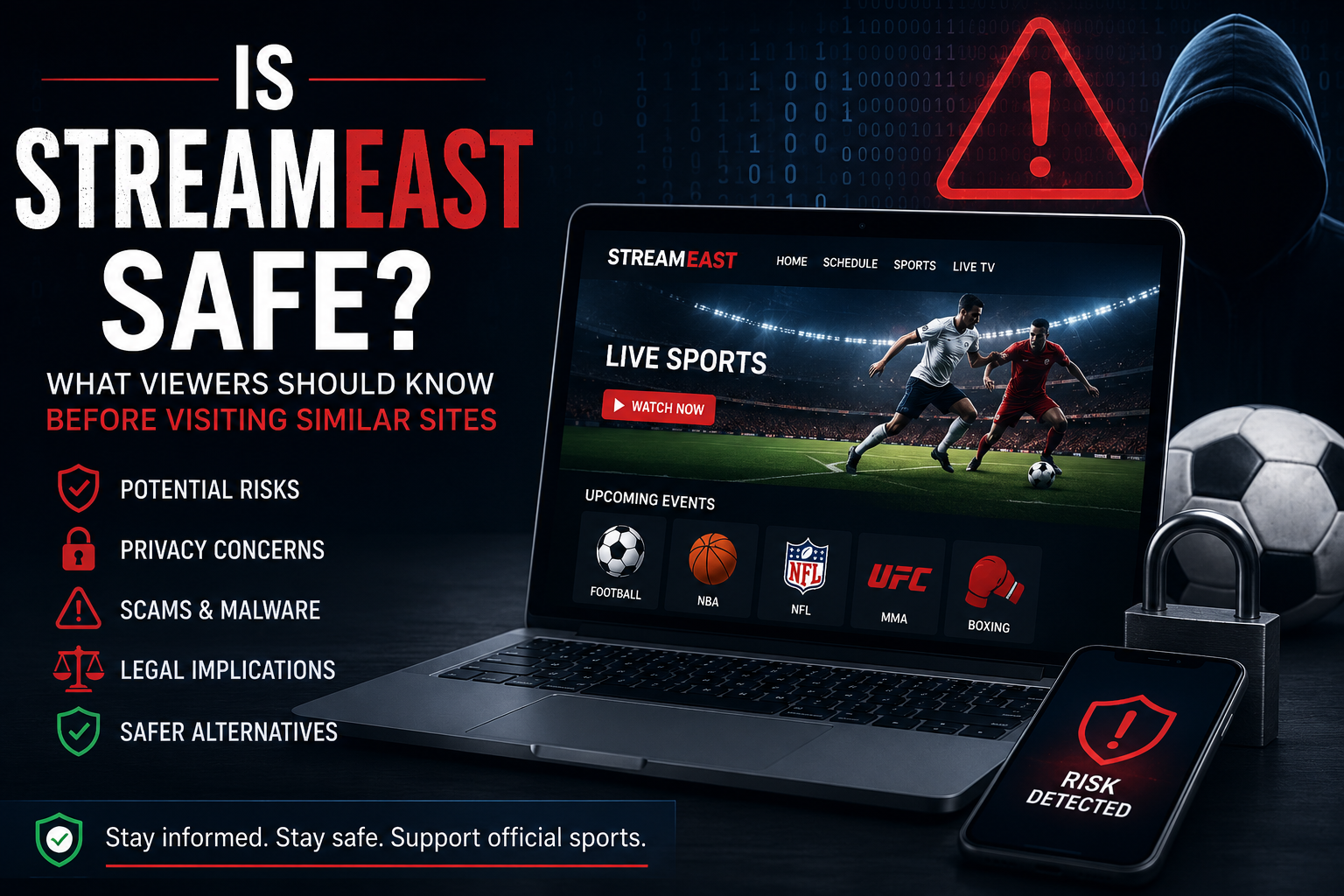
East Stream is a name that often appears when people are looking for live sport online. In most cases, it is not the established title of a separate sports platform. It is usually a reversed version of StreamEast, the name once associated with a large network of unauthorised sports-streaming websites.
The difference may look minor, but it can create genuine confusion. Someone may remember the two words without recalling their original order. A website operator may deliberately use the reversed name to attract people searching for the better-known service. Other pages may combine several versions of the wording, making it appear that they are all part of the same operation.
That assumption should not be made automatically.
The original StreamEast network was reported shut down in September 2025 after action involving Egyptian authorities and the Alliance for Creativity and Entertainment. ACE said the network had operated through 80 associated domains, recorded more than 136 million average monthly visits and attracted over 1.6 billion visits during the previous year.
Since the shutdown, familiar names have continued to appear on copied pages, new domains and unrelated services. A site calling itself East Stream may resemble something viewers have seen before, but its name and appearance do not prove who owns it, whether it is connected to the former network or whether it has permission to show any sporting event.
This guide explains why the name appears, how imitation websites create confusion and what viewers should examine before trusting an unfamiliar page.
What Does East Stream Mean?
East Stream is generally used as a variation of StreamEast rather than as the confirmed name of a completely separate service.
People often reverse or separate words when remembering an online brand. StreamEast may become Stream East in ordinary writing, while East Stream can appear when the order is recalled incorrectly. Autocomplete suggestions, copied posts and similarly named websites can reinforce the variation.
The wording may also be used deliberately.
A website operator knows that many people remember the former platform without knowing its exact address. Using several recognisable versions of the name can help a page attract visitors who type the words differently.
For readers, the practical meaning is simple: the spelling does not verify the website.
A page using East Stream could be a copy, an unrelated sports site, an advertising page or a service created after the original network was closed. Even when the layout resembles an older StreamEast page, that similarity cannot establish ownership.
The wider background is covered in our main StreamEast guide, while Stream East explained looks more closely at access, sports coverage and viewing problems.
Is East Stream the Same as StreamEast?
The two names are closely related in ordinary use, but a current website using East Stream should not automatically be treated as the original StreamEast platform.
The former StreamEast operation was a large network rather than one permanent website. ACE reported that it used 80 associated domains and offered unauthorised access to football, American sports, boxing, mixed martial arts and motorsport.
That history makes the present situation difficult to untangle.
Viewers became accustomed to seeing several addresses connected with the same familiar branding. When one page stopped working, they often looked for another. Today, a copied website can take advantage of that habit by presenting itself as a replacement or mirror.
A visitor may assume that the domain has simply changed again, even when the people behind the page have no connection with the former network.
The safest wording is therefore not that East Stream is definitely the same service. It is that East Stream is commonly used as a variation of the better-known name, while individual websites must be judged on their own ownership and behaviour.
Why Are the Words Sometimes Reversed?
Reversed names are common when people remember a phrase rather than a formal brand.
Someone may hear the name spoken, see it only briefly or encounter it in a social-media comment. Later, they remember “east” and “stream” but place them in the opposite order.
Search suggestions can make the reversed wording appear more established than it really is. Once enough pages and posts use a variation, other writers repeat it. Over time, the alternative version begins to look like a separate platform.
Website operators may also register related names because they know visitors make these mistakes.
A page can place StreamEast, Stream East and East Stream throughout its headings or description, increasing the chance that people recognise at least one version. This does not mean the page represents three services. It may simply be using several forms of the same familiar wording.
The important question is not whether the words are joined, separated or reversed. It is whether the page clearly identifies the organisation behind it and whether that organisation is authorised to distribute the broadcasts it presents.
What Happened to the Original StreamEast Network?
On 3 September 2025, ACE announced that the StreamEast network had been shut down in cooperation with Egyptian authorities.
ACE described the operation as the largest illicit live sports streaming network in the world at the time. It said the associated domains had received more than 1.6 billion visits over the preceding year, with traffic coming primarily from the United States, Canada, the United Kingdom, the Philippines and Germany.
The network was associated with unauthorised broadcasts from major European football leagues, UEFA competitions and international qualifiers. It also carried American sports including the NFL, NBA, NHL and MLB, along with boxing, mixed martial arts, Formula 1 and MotoGP.
ACE said the affected sites would redirect visitors towards information about legitimate viewing services.
The closure explains why an address that once worked may now be unavailable, redirect somewhere else or show completely different content.
It also explains why present-day websites using similar branding deserve careful examination. A familiar name may survive long after the original operation behind it has disappeared.
Readers looking for the full background can continue to what happened to StreamEast.
Why Does the East Stream Name Still Appear?
Popular online names rarely disappear immediately.
Old forum posts remain indexed. Saved bookmarks continue circulating. Social-media messages may be copied long after the original information becomes outdated.
At the same time, new operators may see commercial value in the remaining audience.
A person searching for East Stream is already looking for sport and may be willing to press a play button, allow notifications or try several links before an event begins. That makes the visitor valuable to advertisers, data collectors and dishonest subscription services.
A new page can reproduce the appearance of an older service with relative ease. League names, fixture times and team badges are widely available. A copied colour scheme or logo can create the impression that the viewer has returned to something familiar.
The page may even describe itself as the official replacement.
That claim should not be trusted without reliable supporting evidence. Anyone can place words such as official, new, updated or verified in a page title.
Why Similar Websites Can Look Convincing
A copied streaming page does not need to function well in order to appear genuine.
It may display a complete schedule of upcoming football matches, American sports games and fight cards. The page can include countdown timers, competition logos and images taken from official promotional material.
These details can all be correct while the service itself remains unverified.
A fixture schedule proves only that the operator knows an event is taking place. It does not prove that a legal or dependable video will appear when the event begins.
Some pages use the schedule mainly to attract visitors. The video may remain blank, open an unrelated website or lead through several advertising layers.
Others may embed a working unauthorised feed for part of the event. That still does not establish that the page is trustworthy with personal information, payments or software permissions.
Appearance is therefore one of the weakest ways to judge a streaming site.
Can a Domain Name Prove a Website Is Genuine?
A domain name can offer clues, but it cannot provide certainty on its own.
A familiar phrase may have been registered by anyone. A domain can expire, change ownership or be redirected to a different service. The person operating it today may not be the same person who controlled it several months ago.
The presence of HTTPS and a padlock also has a limited meaning.
It shows that information travelling between the browser and the website is encrypted. It does not confirm that the operator is honest, that the broadcasts are licensed or that payment details will be handled responsibly.
A page may therefore have a secure connection while still using deceptive advertising or collecting information under unclear terms.
All address and domain variations are being kept in one StreamEast addresses guide. Individual address pages would quickly become outdated and could make unknown websites appear more established than they are.
Signs That an East Stream Page May Be Untrustworthy
No single warning sign proves that a website is malicious, but several together should make a visitor leave.
Be cautious when a page:
- opens a new tab every time the player is touched;
- displays several play buttons in the same area;
- asks for notification permission before showing useful content;
- claims that a new player or browser extension must be installed;
- begins downloading a file without a clear request;
- shows a virus warning inside the webpage;
- asks for card details while describing the service as free;
- provides no identifiable company information;
- hides subscription terms or cancellation details;
- uses countdowns to pressure the visitor into acting quickly;
- sends the browser through several unrelated websites;
- asks for permissions that have nothing to do with watching video.
A trustworthy broadcaster should not need to disguise ordinary advertising as player controls.
It should also provide clear information about the organisation receiving payment, what the customer is buying and how the subscription can be cancelled.
Why Fake Play Buttons Are So Common
A fake play button is designed to look like part of the video player while functioning as an advertisement.
The visitor clicks because they believe the event is about to begin. Instead, another page opens. Returning and clicking again may produce a second advertisement or a supposed software update.
This can happen several times before the actual controls appear, if they appear at all.
The design works because sports viewers are often in a hurry. A match may already have started, or the main event may be only minutes away. The closer the event gets, the less time someone feels they have to examine each page carefully.
FACT publicised research in 2022 that examined 50 illegal sports-streaming sites. Every site analysed was reported to contain malicious content, more than 90% were classified as risky and more than 40% lacked a valid security certificate. Visitors were also exposed to scams, banking trojans and explicit pop-ups.
That study covered a particular group of websites rather than every page on the internet. It nevertheless shows why buttons and redirects on unfamiliar sports sites should not be treated as harmless inconveniences.
Why Does an East Stream Page Keep Redirecting?
Redirects are often part of the page’s business model.
The website may earn money when visitors are sent to betting services, subscription offers, software promotions or other advertising pages. Some destinations are merely intrusive, while others may attempt to collect personal or financial information.
The redirect can occur when the viewer presses play, closes an advertisement or clicks what appears to be a volume control.
A more deceptive page may display a message tailored to the visitor’s device. It could claim that the phone is infected, the browser is out of date or the connection must be verified.
These messages are created by the webpage. They should not be confused with genuine warnings from the operating system or trusted security software.
Updates should be obtained through the device’s normal settings or an established application store, not through a prompt attached to an unknown sports player.
Browser Notifications Can Continue After the Match
A notification request may appear harmless because many legitimate websites use alerts.
On an unfamiliar streaming page, however, granting permission can allow the operator or its advertising partners to continue reaching the device after the browser tab has been closed.
The notifications may look like news stories, missed messages, security alerts or prize offers. Pressing one can return the user to the same advertising network or open a different suspicious page.
FACT’s research highlighted notification hijacking as one of the techniques found around illegal sports streams. Users could be tricked into allowing alerts that later delivered scams, explicit material and links to other harmful sites.
Someone who has already allowed notifications can remove the permission through the browser’s site settings.
The exact menu differs between browsers, but the aim is the same: locate the unfamiliar domain and change its notification access to blocked or removed.
Should You Install an East Stream App?
An application using the East Stream name should not be assumed to be official.
Anyone can create an app icon, package a webpage inside an application or publish an installation file using familiar branding.
Software obtained directly from an unknown website may require the user to permit installation from outside the device’s recognised store. That change removes an important layer of review and makes it easier for unsafe applications to reach the device.
Once installed, an application may request access to storage, notifications, location or other information. Those permissions can extend far beyond what an ordinary browser page can do.
FACT’s sports-streaming research described fake mobile applications with privacy problems, expensive in-app purchases and unwanted notification behaviour.
Even an app available through an established store should be checked carefully.
Look at the developer identity, publication history, privacy information and requested permissions. A simple sports-viewing application should not need access to contacts, text messages or unrelated personal files.
What About Browser Extensions and Special Players?
Modern browsers already support the common video formats used by established streaming providers.
An unfamiliar page claiming that a special extension, codec or player is essential should therefore be treated cautiously.
The download may be useless software, an advertising tool or something designed to monitor browser activity.
Extensions can be particularly powerful because they may read and change information on websites the user visits. A harmful extension can affect far more than one sports page.
It may alter search results, insert advertisements or monitor data entered into forms.
A service that cannot play video without asking the visitor to weaken browser security is not providing a trustworthy experience.
Leaving the page is safer than installing software simply to see whether a stream eventually appears.
Should You Create an Account?
Registration may be presented as a harmless step needed to verify age, region or device compatibility.
Before submitting anything, ask why the service requires the information and who will receive it.
An unverified page has no clear reason to need a person’s full name, phone number or main email password.
Never reuse a password from another important account.
When the same login details are used across several services, one dishonest or poorly protected website can create a much wider problem. Access to an email account is particularly serious because email can be used to reset other passwords.
A registration form may also transfer the visitor to a different website. The sports branding remains visible, but the account may actually be created with an unrelated subscription company.
Read the web address and terms before continuing rather than assuming every screen belongs to the original page.
Should You Enter Payment Details?
A page describing itself as free should not need card details merely to prove the visitor’s identity.
Some websites use a small verification payment to begin a recurring subscription. Others collect the details directly or pass the visitor to an unrelated service with unclear cancellation terms.
The pressure of an approaching kick-off or main event can make people overlook warning signs.
Before approving a charge, check the legal name of the company, the exact price, the renewal period and the cancellation process. When this information is missing or difficult to understand, do not proceed.
FACT warns that illegal streaming services can expose people to fraud and data theft, particularly when personal or payment information is shared. Its consumer guidance also reports that 49% of respondents who used illegal streams said they or someone they knew had experienced scams, identity theft, fraud or data loss as a result.
Anyone who has already entered card information on a suspicious page should review transactions and contact the card provider when an unknown charge or subscription appears.
Is East Stream Safe on a Mobile Phone?
A mobile browser can open the same page as a computer, but a smaller screen can make deceptive design harder to spot.
An advertisement may cover the real controls. A redirect can imitate a phone alert, and an accidental tap is more likely when several buttons overlap.
Phones also contain valuable personal information.
Email, banking, saved passwords, photographs and social accounts may all be active on the same device. Installing an unknown application or granting unnecessary permissions can therefore create consequences extending well beyond one sports stream.
Live video may consume a significant amount of mobile data as well. An unstable page can make the situation worse by repeatedly reloading the player or opening advertising videos in other tabs.
Official applications generally offer clearer picture-quality controls, account recovery and data-use settings.
Is It Safer on a Smart TV?
A larger screen does not make the source safer.
Smart-TV browsers may receive updates less frequently than mainstream phone or computer browsers. They can also be difficult to navigate, making it harder to close pop-ups or inspect where a button leads.
Casting from a phone improves convenience but does not change the ownership or licensing of the broadcast.
Streaming sticks are legitimate devices when used with authorised applications. The concern begins when users are asked to install unknown packages, modify the device or purchase access from an unverified seller.
UK government guidance states that illicit streaming can take place through a smart TV, laptop, mobile phone, adapted streaming box or app. It also notes that ordinary devices become part of illicit streaming when they are modified or used to access protected subscription content without permission.
The device itself is not the deciding factor. The source and permission to distribute the content are what matter.
Is East Stream Legal in the UK?
A variation in the website’s name does not change the legal position of the broadcasts.
Live sports coverage is protected by copyright and licensing agreements. Rights may be granted to a particular broadcaster, platform and region.
A different website cannot lawfully redistribute the coverage merely because it can place the video inside an online player.
UK government guidance defines illicit streaming as watching content without the copyright owner’s permission, whether it happens through a smart television, computer, mobile phone or another device.
Separate government guidance states that accessing illegal content through an unauthorised website, application, add-on or modified device infringes copyright and may amount to a crime. It also warns about malware, fraud and data theft, with the risk increasing when card details are shared with unregulated sites.
The precise legal consequences depend on individual conduct and circumstances. Operating or selling access to a commercial piracy service is not identical to every form of viewing.
Anyone who needs advice about a specific situation should consult a qualified UK legal professional.
Our fuller guide to whether StreamEast is legal in the UK explains broadcasting rights and viewer responsibility in more detail.
What Sports Might an East Stream Page Advertise?
A page using this name may publish listings for football, NFL, NBA, baseball, ice hockey, boxing, mixed martial arts and motorsport.
That selection reflects the sports associated with the former StreamEast network. ACE said the original operation carried unauthorised coverage from major European football leagues and UEFA competitions, as well as the NFL, NBA, NHL, MLB, boxing, MMA, Formula 1 and MotoGP.
The presence of those sports on a current page does not demonstrate continuity with the former network.
It may simply show that the new operator knows what the old audience expected to find.
A convincing schedule can be assembled from public fixture information. The important test comes when the event begins: whether the player works, where it sends the visitor and what the page asks for in return.
Separate guides cover the main viewing interests associated with the name, including Stream East football, Stream East NFL, Stream East NBA and Stream East Formula 1.
Why an East Stream Page May Stop Working
A page may fail because its domain has been suspended, blocked, abandoned or redirected.
The hosting server may also be overloaded during a major event. Unofficial services rarely offer the infrastructure or technical support expected from established broadcasters.
The problem may lie with the embedded video rather than the page itself.
A website can continue displaying an event while the source feed has disappeared. In other cases, the apparent player may exist only to encourage clicks on advertisements.
Weak Wi-Fi and an outdated browser can contribute to playback problems, but visitors should not assume every failure can be fixed on their device.
Disabling security software, accepting unknown permissions or installing an extension may create a larger problem without restoring the video.
Our StreamEast not working guide covers common playback and access issues without directing readers to replacement domains.
What to Do After Visiting a Suspicious Page
Opening a questionable page does not automatically mean a device has been compromised. It is still sensible to check what happened during the visit.
Close unexpected tabs and cancel downloads that were not intentionally requested.
Review the browser’s download history without opening unknown files. Remove notification permission for unfamiliar websites and look through installed extensions or applications for anything added recently.
Use trusted security software already present on the device. Do not install a supposed antivirus tool offered by the page that caused the concern.
Change any password entered on the website, beginning with the associated email account. Update other accounts when the same password was reused.
When payment information was submitted, review bank or card activity and contact the provider if the company name or transaction is not recognised.
The earlier action is taken, the easier it is to limit potential harm.
How to Find the Official Broadcaster
Start with the organisation responsible for the event.
A league, club, tournament, promoter or governing body will often publish information about its authorised broadcast partners. Make sure the information applies to the United Kingdom, as rights can differ by country.
Then confirm the event through the broadcaster’s own schedule.
Check whether it is included in a subscription, available free to air or sold separately as a pay-per-view event.
Football coverage should be checked by competition rather than only by team. A club’s domestic league, cup and European matches may appear on different services.
The same principle applies to other sports. Boxing events may involve a separate purchase, while American leagues may divide coverage between a UK broadcaster and a league-operated platform.
Our guide to finding the official sports broadcaster provides a practical process for checking before the event starts.
Safer Ways to Follow Sport
Not every legal option requires a long contract.
Some major events are shown on free-to-air television. Official highlights, radio commentary, live text coverage and verified social updates can offer useful alternatives when a full broadcast is not affordable.
Monthly subscriptions may be activated around the part of a season that matters most, provided the cancellation terms are understood.
Households should also check existing broadband, mobile or television packages. Sports access may already be included or available as an add-on.
Public venues can be another practical choice for occasional major events when they use a proper commercial viewing agreement.
The legal StreamEast alternatives for UK viewers guide compares these approaches without presenting copied websites as substitutes.
A Familiar Name Should Still Be Checked
East Stream sounds familiar because it contains the same two words associated with the former StreamEast network.
That familiarity is not proof of ownership.
The reversed wording may come from an innocent typing habit, a copied article or a website deliberately trying to attract people who remember the original service.
A visitor should therefore judge the page by what it does, not simply by what it calls itself.
Repeated redirects, disguised advertisements, unnecessary downloads and unclear payment requests are reasons to leave. A polished schedule and familiar logo are not enough to outweigh those concerns.
Stream-east.org.uk is an independent informational publication. It is not affiliated with the former StreamEast network or with current websites using similar names. It does not host live sporting events or provide links to unauthorised broadcasts.