

For a long time, people searched StreamEast because they wanted a free way to watch live sports online. Now the search intent is different. A lot of users are not just asking where the site went. They are asking whether StreamEast was illegal, whether the copycat domains are safe, and whether watching those streams can expose them to copyright trouble, malware, phishing, identity theft, or aggressive pop-ups.
That shift matters because the story around StreamEast is no longer just about free sports streaming. It is about legality, safety, and what happened after the shutdown.
The biggest reason this keyword keeps growing is simple: StreamEast was widely described as an unauthorized sports-streaming operation, and the main network was shut down in 2025 after an anti-piracy investigation involving the Alliance for Creativity and Entertainment and Egyptian authorities. Reports tied it to unauthorized streams of events from leagues and competitions like the NFL, NBA, MLB, NHL, Premier League, and Champions League, and many former StreamEast domains were redirected after the takedown.
That also explains why the strongest SEO field around this topic is bigger than one question. People searching is streameast illegal are usually also asking is streameast safe, why is streameast not working, what happened to streameast, are streameast mirror sites safe, and what are the legal alternatives. If you want this article to satisfy real Google search intent, it has to answer all of those naturally, not just repeat the word illegal a dozen times.
Is StreamEast Illegal?
In plain English, StreamEast was generally treated as illegal because it offered unauthorized sports streams without owning the broadcast rights or licensing rights required to show that content legally. That is the core issue.
This was not a case of a site simply being “free” or “cheap.” The problem was that it gave users access to copyrighted live sports without authorization from rights holders, broadcasters, or leagues. That is why coverage around StreamEast consistently uses terms like illegal sports streaming, sports piracy, unauthorized broadcast, and copyright infringement.
That distinction matters because many users still talk about sites like this as if they exist in a legal gray area. In practice, the main complaint from rights owners is not vague or technical. It is that these are unlicensed streams and unauthorized rebroadcasts of protected live content.
Broadcasters pay huge sums for exclusive media rights. When an unlicensed site streams those same events for free, that undercuts the licensing system that paid for the broadcast in the first place.
It is also worth separating two things that people often mix together. The operator risk and the viewer risk are not identical. The heaviest enforcement usually lands on the people running the piracy network, hosting it, monetizing it, or helping distribute it across mirror domains.
That said, “I am only watching” is not the same as “there is no risk.” Users can still be exposed to ISP warnings, privacy issues, tracking, scams, and the security problems that tend to follow illegal streaming ecosystems.
Another reason this question gets so much traffic is that people assume legality and safety are the same thing. They are not. A site can be obviously unauthorized and also be extremely risky from a security point of view. That is why searches like is streameast legal, is streameast legit, is streameast safe, and is streameast a scam all cluster around the same intent.
Users want to know whether the site breaks copyright rules, but they also want to know whether it can damage their devices, steal data, or lead them onto spoofed domains full of malicious ads and fake play buttons.
Why So Many People Started Asking This More Seriously
The question got sharper after the 2025 crackdown. Before that, a lot of people treated StreamEast like just another free sports streaming website. After the takedown, the conversation changed. Once a site is publicly described as part of a piracy network and its domains are seized or redirected, users stop asking whether it is simply “popular” and start asking whether it was illegal all along. That is exactly what happened here.
Reports described StreamEast as operating across 80 associated domains and drawing more than 1.6 billion visits over the previous year. That scale is a big part of why the story got so much attention. This was not some tiny hidden stream aggregator with a small user base.
It was described as the largest illicit live sports streaming operation in the world, with major traffic from countries including the United States, Canada, Britain, the Philippines, and Germany.
It also covered the exact sports properties that drive search demand. The reporting linked StreamEast to unauthorized access to games and events from the NFL, NBA, MLB, NHL, top European soccer leagues, and other major competitions.
When one platform touches that many sports audiences at once, it naturally becomes a huge SEO entity. Searches like stream nfl free, free nba stream, watch boxing free, free soccer streams, and free ufc stream all end up orbiting the same central question: is the platform legal, and what risk comes with using it?
What Happened to StreamEast in 2025
The short version is that the original network was taken down after a year-long investigation. The Associated Press reported that the shutdown was carried out with Egyptian authorities and ACE, and The Verge reported that the action disrupted the platform’s streaming infrastructure after an operation on August 24, 2025. After the enforcement action, all StreamEast domains were redirected to ACE’s Watch Legally page.
That redirection matters because it was not just symbolic. It told users that the old domains were no longer functioning as they had before, and it pushed them toward licensed options instead. On the ACE site, the message is direct: watching pirated content puts your cyber-safety at risk, and users are urged to use legal providers instead. ACE also says its Watch Legally resource points people toward more than 140 legitimate content providers and platforms around the world.
The shutdown also happened at a very strategic time. Coverage noted that the disruption landed right as major sports seasons were starting up again, including the new European soccer season and the NFL season. That timing increased public attention because users immediately noticed missing streams, site outages, and domain redirects just as demand for live sports access was rising.
Why StreamEast Links Keep Changing
One of the biggest reasons this keyword is still alive is the mirror-site problem. Even after the main network was shut down, websites using the StreamEast name kept appearing. The Verge reported that ACE said it was investigating whether those active sites were remnants of the original platform or copycat sites made by impersonators. That is an important distinction because many users assume that if a StreamEast-branded site still loads, then “the real one” must be back. That is not a safe assumption.
This is where searches like streameast mirror sites, streameast clone sites, streameast fake mirrors, streameast new domain, and why do streameast links keep changing make perfect sense. Domain hopping is common after takedowns. A site name with strong recognition attracts traffic, so copycat pages, proxy sites, and spoofed domains appear quickly. Some are direct imitators. Some are low-quality clones built mainly to harvest clicks, data, or ad revenue. Others are outright scam websites hiding behind familiar branding.
That is also why the access issue and the safety issue overlap. When a platform is repeatedly taken offline, blocked, redirected, or replaced, the odds go up that users will land on the wrong domain. Once that happens, they are not just dealing with an unauthorized stream. They may be dealing with malicious redirects, fake download buttons, scam links, drive-by downloads, or phishing pages dressed up to look like a sports stream site.
Is StreamEast Safe to Use?
From a security perspective, the answer is that it carries real risk. Even before you get into the copyright side, the bigger consumer problem is that illegal streaming ecosystems are frequently tied to malware, phishing, data harvesting, and aggressive advertising. ACE says piracy sites expose users to dangers like identity theft and malware, and its September 2025 piece on live sports piracy said piracy platforms can carry a 25 times higher risk of malware and fraud than legitimate services.
That same ACE article goes further and says fans drawn in by “free” streams are often targeted by identity theft schemes, ransomware, and financial scams. It also cites research suggesting consumers using piracy sites face 22 to 28 times more cyber threats than on mainstream platforms. That is exactly why keywords like streameast malware risk, streameast phishing, streameast scam ads, streameast ransomware risk, and streameast unsafe website warning belong naturally in this topic. They are not side issues. They are part of the main user concern.
Recent safety-focused coverage says the same thing in more practical language. Spocket’s 2026 safety article warns that aggressive ads and overlays on StreamEast-type sites can redirect users to phishing pages, fake software downloads, or harmful pop-ups, and it says mirror or clone sites are especially risky because anyone can create a fake version that looks real. It also highlights tracking scripts, unclear ownership, and the lack of transparency users would expect from a legitimate platform.
This is why many users who ask is streameast safe on phone or is streameast safe on laptop are asking the right question for the wrong reason. The device does not change the core issue. If the site is operating through unstable mirrors, fake domains, intrusive ads, and questionable redirects, then the risk follows you whether you are on desktop or mobile. In some cases, mobile users may even be more vulnerable to fake app prompts, suspicious APK files, or spoofed pages that are harder to inspect quickly on a smaller screen.
Can Users Get in Trouble for Using It?
This is the part where people want a simple yes-or-no answer, but it is better to be honest. The biggest enforcement efforts usually target the operators, distributors, and monetizers behind the piracy network. That is where the domain seizures, arrests, and takedown actions are focused. But from a user point of view, “less likely to be targeted than the operator” does not mean “risk-free.”
At minimum, users are exposing themselves to privacy risk, possible ISP visibility, and scam exposure. Spocket notes that illegal streaming platforms may use third-party trackers and collect browsing data, IP addresses, and device identifiers without clear controls. That means the risk is not only legal. It is also about who is collecting your data, what scripts are running in the background, and whether your click path is being monetized through fraud-heavy advertising networks.
It is also important not to confuse private browsing or a VPN with legal protection. A privacy tool can help with network privacy in some situations, but it does not transform an unauthorized broadcast into a licensed stream. That is why searches like is streameast illegal to use with a vpn or can your isp see streameast often reveal the real mindset behind the query. Many users are not only asking whether the stream is illegal. They are trying to work out whether they can hide the behavior. That is a different question, and it does not change the copyright issue underneath it.
Why Unauthorized Sports Streams Are So Unstable
One thing people often notice before they even think about the law is that these sites are unstable. Domains disappear. Streams fail. Links change. Playback breaks. Pop-ups take over the page. That instability is not a random design flaw. It is part of how unauthorized streaming ecosystems function when they are constantly trying to avoid enforcement, hosting disruption, and domain seizures.
Once a major brand like StreamEast is taken down, instability usually gets worse, not better. You no longer have one dominant destination. You have copycat pages, mirror domains, cloned interfaces, and replacement sites all trying to capture the same traffic. That means users may search why is streameast not working, is streameast down, or what happened to the original streameast when the more accurate answer is that the branded search now points into a fractured landscape full of redirects, clones, and safety problems.
Better Ways to Watch Sports Legally
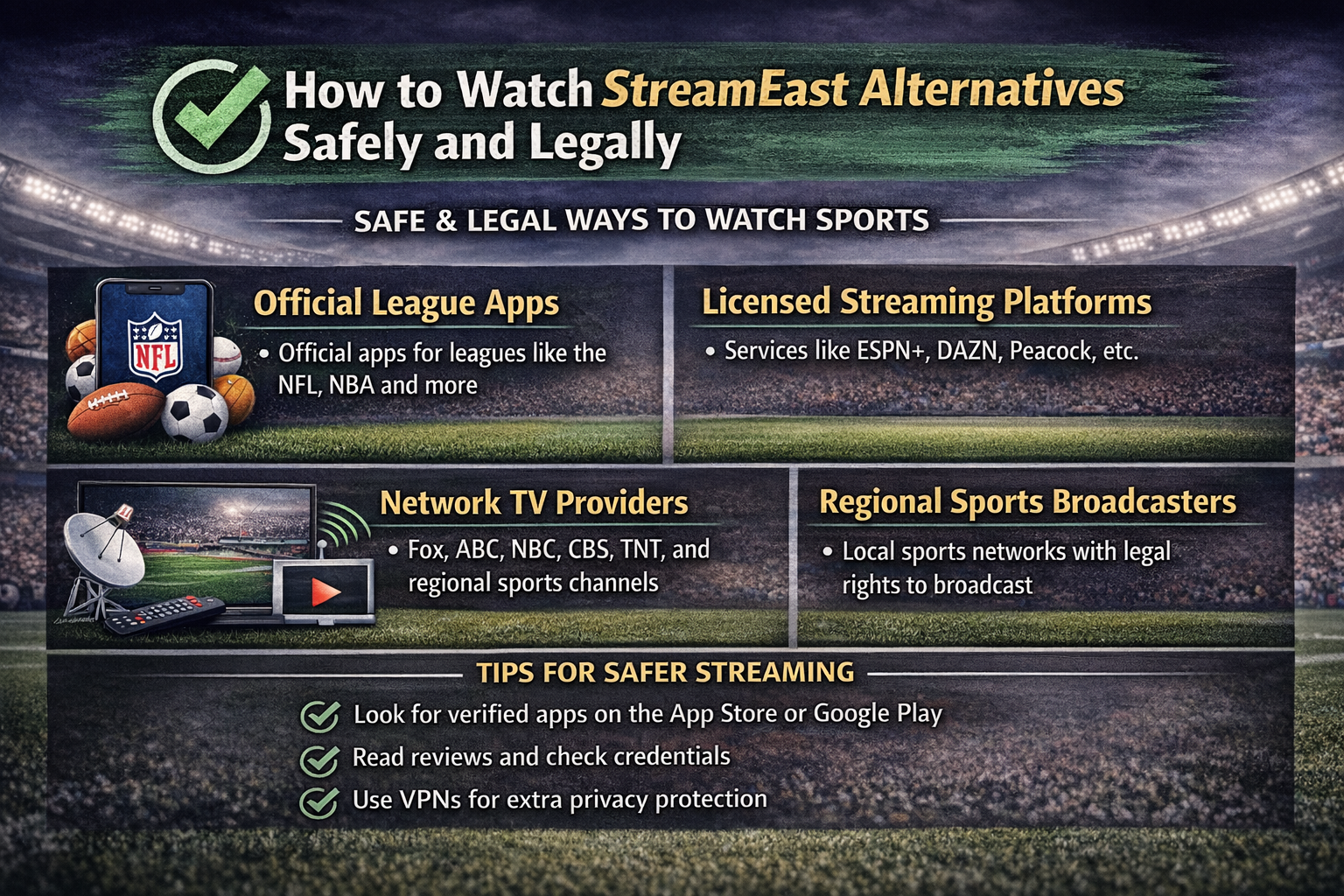
The most practical alternative is still the least exciting answer: use the official broadcaster, league app, or licensed streaming service for the event you want to watch. That is not just the legal option. It is also the safer and more reliable option. ACE’s Watch Legally page exists for exactly this reason and says users can find more than 140 legitimate providers around the world.
For live events, the legal route often depends on the rights holder and the channel. For example, current March Madness coverage in the U.S. is split between CBS and Warner Bros. Discovery networks, with CBS games available through services like Paramount+ Premium and Warner networks available through Max, while cable-replacement services like YouTube TV, Hulu + Live TV, and Sling carry the relevant channels. A digital antenna can also provide free access to CBS in some areas. That is the type of answer users actually need when they are looking for streameast legal alternatives or trying to watch sports legally without stumbling onto another unsafe sports mirror site.
The bigger point is that legal alternatives do not only reduce legal risk. They also solve the quality problem. You get stable playback, clear ownership, predictable apps, customer support, and far less exposure to fake play buttons, malicious ads, fraudulent popups, or unsafe redirects. When people compare a licensed stream with an unlicensed stream, they often frame it as price versus convenience. In reality, the comparison is also legality versus instability, and convenience versus cyber risk.
Common Questions People Still Ask
Can you still use Streameast?
You can still find sites using the StreamEast name, but that does not mean the original network is safely or legitimately back. After the 2025 action, former domains were redirected to ACE’s Watch Legally page, while The Verge reported that other StreamEast-branded sites were still online and under review as possible remnants or copycat impersonators. So the practical answer is that you may still find something using the name, but you cannot assume it is the original platform, and you definitely cannot assume it is safe.
Why is Streameast banned?
Because it was described as an unauthorized sports-streaming network that offered copyrighted live broadcasts without the required rights or licenses. The shutdown was presented as an anti-piracy enforcement action involving ACE and Egyptian authorities after a year-long investigation. In other words, it was not banned because it was merely free or unpopular with broadcasters. It was targeted because it was operating as an illicit live sports streaming service.
Is it illegal to watch live streams?
Watching a live stream is not automatically illegal. Watching a licensed live stream from an official broadcaster is legal. The issue is the source. If the stream is an unauthorized rebroadcast of copyrighted sports content, then you are dealing with a different category entirely. That is why users should stop thinking in terms of “live stream versus not live stream” and start thinking in terms of licensed versus unlicensed, official versus copycat, and legal broadcaster versus piracy network.
How did Streameast get caught?
Public reporting says the takedown followed a year-long investigation and a coordinated enforcement action with Egyptian authorities. The platform’s size made it highly visible: it was reported to have operated across 80 domains and drawn more than 1.6 billion visits in a year. At that scale, it was not a small hidden site anymore. It was a major piracy network with enough traffic, reach, and brand recognition to become a top anti-piracy target.
Why Free Sports Streaming Still Pulls So Much Traffic
One reason StreamEast became such a huge search term is that sports access has become more fragmented and more expensive than many fans expected. A recent AP report said the U.S. Department of Justice is investigating the NFL over potential anticompetitive concerns tied in part to consumer affordability and fair competition among providers, and it noted that fans now face a growing mix of broadcast channels and streaming subscriptions to follow games. That does not make unauthorized streams legal, but it does explain why users keep searching for free workarounds when they feel priced out or spread across too many services.
That frustration is exactly why a platform like StreamEast could grow so large in the first place. When sports fans need one service for one package, another for playoff games, another for European soccer, and still another for pay-per-view events, the temptation of a single free sports streaming site becomes obvious. The legal problem, though, never changed: unauthorized access to live sports rights is still unauthorized access, no matter how inconvenient the licensed market feels.
This is also why search phrases like watch games free, watch live sports free, stream without cable, and watch pay per view free sit so close to searches like is streameast illegal and is streameast safe. Users are not only looking for the law in the abstract. They are reacting to the real economics of modern sports viewing, then trying to calculate whether the shortcut is worth the legal consequences, privacy exposure, malware risk, and platform instability that come with it.
How to Tell a Legal Stream From a Copycat or Risky One
A licensed stream usually gives you clear signals. You know who the broadcaster is, who owns the app, what company is charging you, what event rights it has, and where customer support lives if something breaks. With a risky or spoofed stream, those signals are either missing or replaced with vague branding, fake countdown timers, broken menus, “working links” pages, or pop-ups that try to push downloads before playback ever starts. That is one reason the post-shutdown StreamEast landscape is so messy: once the original domains were redirected, lookalike pages had room to fill the gap.
The mirror-site problem is not theoretical. Spocket’s safety analysis says StreamEast frequently changes domains to evade shutdowns and that “mirror” or “clone” sites are especially dangerous because anyone can create a fake version that looks identical to the original. The same article says many of these copies are loaded with malware, crypto-mining scripts, or phishing pop-ups. That matches the wider post-takedown pattern reported elsewhere: users search for a known name, land on a familiar-looking clone, and assume they found the real thing.
A good rule of thumb is simple. If a site hides ownership, floods you with redirects, pushes fake player updates, or forces you through multiple ad layers before showing a stream, that is already a warning sign even before you get to the legal side. Google’s own Chrome safety guidance says users may see dangerous-site warnings for phishing or malware pages and recommends not visiting those sites when the red warning appears. In other words, if your browser is already trying to stop you, that is not something to brush off casually.
What to Do If You Already Clicked a StreamEast Mirror or Fake Domain
If someone already clicked a suspicious StreamEast link, the first thing is not to panic and keep clicking. The safer move is to stop interacting with the page, do not enter any login or payment details, and close it out. The FTC says phishing attempts should be reported, and Google warns that phishing and malware sites can trigger dangerous-site alerts for a reason. If a page looked off, asked for credentials, or pushed a download, treat that as a real security event, not a minor annoyance.
The next step is to scan the device and make sure your security software is up to date. The FTC’s malware guidance says users should use security software, keep it updated, and set it to scan new files automatically. If the site pushed anything onto your device, even a fake player update or suspicious extension, it is smart to run a full scan rather than assume nothing happened.
If you entered a password on a suspicious page, change that password through the real site, not through any link the stream page showed you. Government and consumer-safety guidance is consistent on this point: phishing pages are designed to steal credentials, and if you think something may have been captured, update passwords and avoid entering sensitive information on a device you believe may still be compromised. Australia’s cyber guidance specifically says not to enter passwords or other sensitive information on an infected device and to make sure the device is clean before changing passwords.
This practical cleanup angle matters because a lot of StreamEast-related content stops at “it might be dangerous” and never tells the user what to do next. But from a real-world point of view, the cleanup steps matter as much as the warning. If the harm from a risky streaming site can include phishing, ransomware, malicious scripts, browser hijacks, or identity theft attempts, then the article should help readers respond intelligently instead of just scaring them.
Why the “Safe Free Sports Streaming” Search Is So Hard to Satisfy
Many users search for safe free streaming sites as if those two words naturally belong together. The problem is that in the sports space, “free” and “safe” often pull in opposite directions once you leave official providers. Spocket’s piece says very few free sports streaming sites are truly safe and points people instead toward limited legal options like official apps or legitimate broadcaster-backed streams. That is a much more realistic answer than pretending every free stream site is equally risky or equally usable.
The better way to think about it is this: free legal sports viewing does exist, but it is usually tied to specific broadcasters, regional rights, free trials, ad-supported official platforms, or occasional over-the-air games, not to anonymous mirror domains with shifting URLs. Once you understand that difference, the search intent becomes clearer. People are not always looking for “free” in the piracy sense. Often they are looking for a cheaper or simpler legal path that does not involve malware, pop-ups, or copyright risk.
What Legal Alternatives Actually Look Like in Practice
One mistake people make is assuming “watch legally” is too vague to be useful. In reality, legal access depends on the event. For March Madness 2026 in the U.S., coverage has been split across CBS, TBS, TNT, and truTV, with CBS-related access through Paramount+ and TNT/TBS/truTV access through Max, while live-TV streaming services like YouTube TV can cover the broader channel lineup. YouTube TV has also promoted a free trial around the tournament. That is a much more grounded answer than simply telling users to “subscribe to something” with no specifics.
The same logic applies outside college basketball. Rights vary by sport and region. A Champions League viewer in the U.S. may need Paramount+, while viewers in other countries may have different official broadcasters. FourFourTwo’s current guide notes that U.S. Champions League coverage is carried on Paramount+, while other countries rely on services such as TNT Sports, Amazon Prime Video, DAZN, Stan Sport, RTÉ, or Virgin Media depending on territory. That is why legal streaming alternatives are not one-size-fits-all. The smart move is to follow the broadcaster with the actual rights in your market.
This is also where ACE’s Watch Legally campaign becomes relevant. Its site says users can find more than 140 legitimate and legal content providers and platforms around the world. That does not mean every event is cheap or simple to access, but it does mean there is a much safer route than hunting through fake StreamEast domains, clone sites, and aggressive ad networks. Legal streaming services may cost more upfront, but they also give you predictable quality, clearer privacy expectations, and far less exposure to phishing, malware, and data harvesting.
Why This Topic Keeps Ranking So Well
From an SEO point of view, is streameast illegal keeps ranking because it is not just one question. It is really a cluster of connected fears and needs: is streameast legal, is streameast safe, what happened to streameast, why was streameast shut down, are streameast mirror sites safe, can you get in trouble for using streameast, and what are the legal alternatives. The pages that perform best are usually the ones that address the full user journey instead of answering only the headline.
That is also why the strongest semantic field around this keyword is not just legal language like copyright infringement, piracy investigation, takedown notice, domain seizure, and enforcement action. It also includes cyber-risk language like phishing, malicious ads, fake domains, copycat pages, privacy exposure, data harvesting, and identity theft, plus practical viewing terms like official broadcasters, licensed streams, sports subscriptions, broadcaster apps, and watch legally. That combination mirrors how people actually search after the StreamEast crackdown